





An Encore After Pluto
For many, the story of New Horizons reached its climax in July 2015. After a nine-year journey across the solar system, the piano-sized probe executed a flawless flyby of Pluto, transforming our perception of the dwarf planet from a fuzzy speck into a complex
and beautiful world. The high-resolution images it sent back revealed towering mountains of water ice, vast plains of frozen nitrogen, and a surprisingly hazy atmosphere. The mission showed that Pluto was not a dead, inert ball of ice but a geologically active world, one that scientists now believe may even harbor a liquid water ocean deep beneath its surface. For any other mission, this groundbreaking encounter would have been a spectacular grand finale. For New Horizons, it was just the beginning of its second act.
The Most Distant Encounter in History
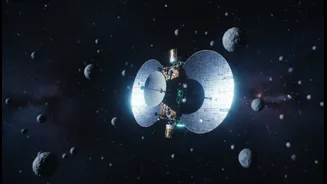
With its primary mission complete, the spacecraft’s team steered it deeper into the Kuiper Belt, the vast, icy debris field beyond Neptune. On New Year’s Day 2019, New Horizons made history again. It flew past Arrokoth, a small object a billion miles beyond Pluto. This made Arrokoth the most distant and most primitive object ever explored by a spacecraft. The first clear image revealed a stunning sight: a reddish, double-lobed object that looked like a gently fused snowman. Its appearance provided powerful evidence for how the building blocks of planets may have formed—not through violent collisions, but through a gentle, slow-speed coalescence. Arrokoth was a time capsule from the dawn of the solar system, preserved in the deep freeze of the outer reaches for over 4.5 billion years.
A New Mission in the Void
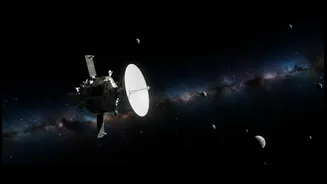
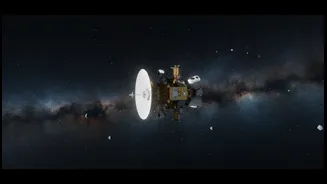
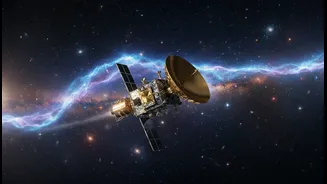
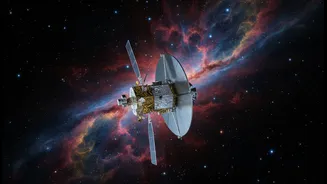
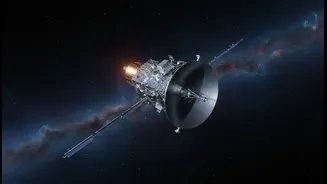
After the Arrokoth flyby, New Horizons entered a new phase. Without another flyby target currently in range, its mission has shifted. In early July 2026, after a 321-day hibernation to conserve resources, the probe awoke to begin its work as a one-of-a-kind observatory in the outer solar system. While its main cameras are less active, its other instruments are constantly working. The Venetia Burney Student Dust Counter measures the distribution of dust particles, while other sensors study the solar wind—the stream of charged particles flowing from the sun. From its unique vantage point, New Horizons can measure how this wind behaves as it travels toward the edge of the solar system, providing data the Voyager probes couldn't.
The Eyes and Ears of Deep Space
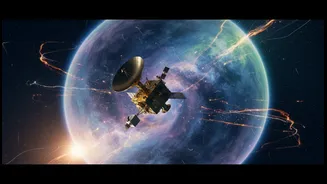
The spacecraft’s new job is more subtle than its previous daredevil flybys, but no less important. It is taking the first-ever measurements of the heliosphere from this distant region. Recent data has shown that the solar wind slows down as it interacts with interstellar gas filtering into our solar system. In the coming weeks, it will use its ultraviolet spectrograph to study the distribution of primordial hydrogen gas. This work helps scientists map the boundary between our solar system and interstellar space, a critical step in understanding our place in the galaxy. The mission is also a testbed for future interstellar navigation, using the apparent shift of nearby stars to pinpoint its location in three-dimensional space—a first for any spacecraft.
The Long Road Ahead
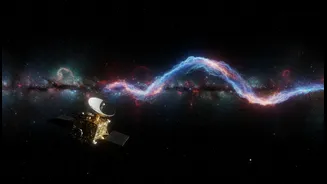
So what's next? NASA has extended the New Horizons mission until at least 2028 or 2029, when it is expected to leave the Kuiper Belt entirely. The operations team continues to scan the skies with powerful ground-based telescopes, like the Vera C. Rubin Observatory, hoping to find one last Kuiper Belt object the spacecraft could visit. While finding a suitable target is a long shot, it is not impossible. Even if no new target is found, the probe has enough power from its radioisotope thermoelectric generator to continue sending back valuable science data from the frontiers of the solar system well into the 2030s. Having already rewritten the textbooks on the outer planets, this intrepid explorer continues to work, quietly listening to the whispers from the edge of the sun's influence.