



The Challenge of Finding Your Way
Navigating on the Moon isn't as simple as pulling out a smartphone. There is no existing GPS network orbiting the Moon, which means all positioning, navigation, and timing (PNT) data has historically relied on a constant and cumbersome connection with
Earth. Every rover, lander, and orbiter has to be meticulously tracked by the Deep Space Network (DSN), a series of massive radio antennas on Earth. This process is complex and resource-intensive, creating a bottleneck that limits the number of missions that can be managed at once. For future ambitions, like establishing a permanent human presence under the Artemis program, this reliance on Earth-based support is a significant hurdle. To enable fleets of rovers, astronauts exploring far from their landers, and automated construction, the Moon needs its own version of GPS.
NASA's Answer: A Lunar GPS Beacon
Enter NASA's new generation of navigation payloads, a key part of a larger concept called LunaNet. This initiative aims to create an internet-like network for communications and navigation around the Moon. A crucial early demonstrator of this technology is the Lunar Node-1 (LN-1) payload, a small, S-band navigation beacon developed at NASA's Marshall Space Flight Center. Think of it as the first 'cell tower' for the Moon. The LN-1, which flew aboard an Intuitive Machines lander, was designed to test autonomous navigation by broadcasting its position and timing information. This allows other assets—like rovers or even astronauts—to determine their location relative to the beacon without having to check in with Earth every time. It's the first step toward a web of interconnected nodes that will work together to provide seamless lunar navigation.
How the Technology Works
The LN-1 payload functions as a surface-based radio beacon. It receives data from Earth to know its precise location, but from there, it acts as an independent navigation aid for its local surroundings. The system relies on software known as the Multi-spacecraft Autonomous Positioning System (MAPS), which uses the radio signals to enable assets to calculate their position autonomously. Future versions and additional nodes will expand on this. Some experiments, like the NavCube3-mini delivered in July 2026 for Intuitive Machines' Altus-1 relay satellite, are designed to use faint signals from Earth's existing GPS and Galileo satellites to calculate position at a lunar distance. The long-term vision is a hybrid system: a constellation of lunar-orbiting satellites and surface beacons working in concert, much like our terrestrial GPS.
Unlocking a New Era of Autonomy
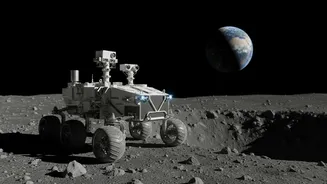
The implications of a successful lunar PNT system are enormous. With reliable, independent navigation, lunar missions can become far more ambitious and efficient. Rovers could autonomously navigate complex terrain on the far side of the Moon, an area that lacks a direct line-of-sight to Earth. Astronauts could venture further from their landing sites, confident in their ability to find their way back safely. Landers could achieve landings with pinpoint precision, which is critical for building a proposed Artemis base camp at the lunar south pole. This technology effectively gives spacecraft and explorers more autonomy, reducing their reliance on constant communication with mission control and freeing up valuable DSN resources for deep-space missions to Mars and beyond.
The Road to a Connected Moon
The LN-1's demonstration on the lunar surface was a foundational moment, providing crucial data on how such systems perform in the harsh lunar environment. The journey is part of NASA’s Commercial Lunar Payload Services (CLPS) initiative, which partners with private companies like Intuitive Machines to deliver science and technology to the Moon. The next phase involves deploying more advanced navigation payloads and dedicated relay satellites. International partners like the European Space Agency (ESA) are also contributing to the LunaNet framework. Together, these efforts are building, piece by piece, the essential infrastructure needed for a sustainable, long-term human and robotic presence on the Moon, turning science fiction into operational reality.