







Decoding a Global Symphony
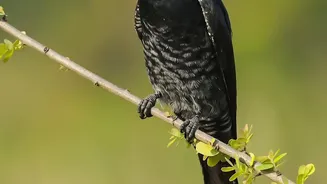
From the simple whistle of a sparrow to the complex melody of a nightingale, the diversity of birdsong is astounding. For centuries, this variety was seen as nearly infinite. A recent study, however, challenges that notion. Researchers have discovered
that the songs of thousands of species of passerine birds—the group that includes most songbirds—might be constructed from a universal toolkit of only eight fundamental acoustic patterns, or motifs. This unprecedented research, published in the journal Science, analyzed a massive dataset of over 116,000 song recordings from 3,160 different species. To do this, scientists led by Quentin Bacquelé in France used machine learning to analyze the structure of sounds, moving beyond simple pitch and frequency to understand their complex texture over time.
The Eight Building Blocks
So, what are these fundamental elements of birdsong? Think of them not as notes, but as types of sound textures. The study identified eight distinct motifs that appear in various combinations. They include three kinds of trills (slow, fast, and ultrafast), three types of whistles (flat, slow-modulated, and fast-modulated), and two more complex sounds described as 'harmonic stacks' and 'chaotic notes'. For example, the plaintive 'pee-ah-wee' of the Eastern Wood-Pewee is a perfect illustration of a slow-modulated whistle. In contrast, the high-pitched, rapid-fire sound of a Bohemian Waxwing showcases an ultrafast trill. These building blocks are like a shared set of LEGO bricks; while the number of bricks is limited, the ways they can be combined are nearly endless.
A Mix-and-Match Approach
Interestingly, most birds don't use all eight motifs. The study found that the average songbird species has about five of the eight types in its repertoire. Typically, a species will rely heavily on one dominant motif, using it in the vast majority of its songs. However, nearly two-thirds of all songs analyzed combined multiple motifs, creating more complex and layered calls. This mix-and-match strategy allows for immense diversity while drawing from a common wellspring of sounds that evolved early in the history of songbirds. The specific combination a species uses is not random, but rather shaped by its environment and evolutionary history.
Why Habitat Shapes the Song
The research also sheds light on why birds in different parts of the world sing differently. It’s a trade-off between carrying information and being heard. In dense, tropical rainforests, sound doesn't travel as far and can be muffled by vegetation. As a result, birds in these environments often favor structurally simple motifs like flat whistles, which are less likely to be distorted. Conversely, in more open temperate regions, birds often use more complex motifs like ultrafast trills. These information-rich songs can carry more detailed messages over shorter distances, which is crucial during intense, seasonal mating periods. A bird's song is therefore a delicate balance between its evolutionary inheritance and the physics of its immediate surroundings.
A New Framework for Communication
This discovery provides a powerful new framework for understanding animal communication on a global scale. By identifying these foundational motifs, scientists can now ask more specific questions about how songs evolve, how birds learn, and how they might adapt to changing environments, including human-made noise. The methodology itself, which uses advanced AI to parse huge datasets of community-sourced recordings from platforms like iNaturalist and xeno-canto, opens the door for similar large-scale analyses of other animal sounds, from the croaks of frogs to the calls of whales. It represents a major leap forward in our ability to listen in on the conversations of the natural world and understand their underlying structure.