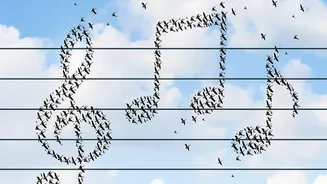








A Global Chorus, A Single Songbook
It’s one of nature’s most complex forms of communication, a symphony that changes across continents and seasons. For centuries, the sheer variety of birdsong has fascinated and baffled scientists. But a groundbreaking study has found a stunning simplicity
underlying this diversity. Researchers in France led an unprecedented effort, using artificial intelligence to analyse over 116,000 song recordings from more than 3,100 species of passerine birds—the group that includes most songbirds. The data, sourced from citizen-science platforms like iNaturalist and xeno-canto, allowed for a global-scale analysis that revealed a common foundation for nearly all the songs they studied.
The Eight Building Blocks of Birdsong
The study, published in the journal Science, identified eight recurring sound types, or "acoustic motifs," that birds combine to create their unique calls. Think of them as the universal alphabet of birdsong. These eight patterns are: three types of trills (slow, fast, and ultrafast), three types of whistles (flat, slow-modulated, and fast-modulated), and two more complex sounds known as harmonic stacks and chaotic notes. While a specific species might only use a few of these in its repertoire—the average is about five—their songs are all drawn from this shared toolkit. The familiar "pee-ah-wee" of the Eastern Wood-Pewee is a classic slow-modulated whistle, while the sound of an American Crow demonstrates harmonic stacks.
An Evolutionary Trade-Off
So why does one bird produce a simple whistle while another creates a rapid, complex trill? The answer lies in an evolutionary trade-off between how much information a song can carry and how far it can travel. The researchers discovered a clear link between a bird’s environment and the types of motifs it uses. Simpler songs, like flat whistles and slow trills, don't get as distorted over distance and can cut through dense vegetation or the chorus of other animals. Consequently, they are more common in birds living in tropical forests or those that need to communicate over long ranges.
Complexity for Close Quarters
In contrast, more complex songs are favoured by birds in temperate regions or those that interact at close range. Ultrafast trills and fast-changing whistles can pack more information into a call—details about fitness for a potential mate or the urgency of a territorial warning—but they degrade more quickly over distance. Physical characteristics also play a role. The study found that larger birds tend to produce simpler sounds, while smaller birds, which may have finer muscular control, are more likely to produce difficult, fast-changing notes.
A New Way of Listening
This discovery provides a powerful new framework for understanding not just birds, but potentially all animal communication. Lead researcher Quentin Bacquelé noted that the findings could help scientists monitor how bird populations might adapt to the increasing noise pollution from human activity. For the rest of us, it offers a new layer of appreciation for the natural world. Knowing that the seemingly chaotic morning chorus is actually a structured orchestra, with each musician playing from the same ancient songbook, changes how we hear it. It’s a reminder that even in the most diverse expressions of life, there are often elegant, underlying rules that connect everything.