

India’s first-ever solar observatory, Aditya-L1, is already changing how we see the Sun. A recent observation has challenged a long-held belief, revealing that a massive solar eruption did not expand evenly like a bubble, but grew asymmetrically.
India’s Watchful Eye on the Sun
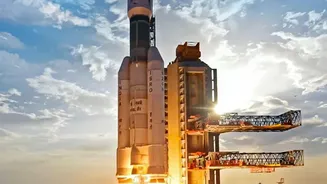
Launched
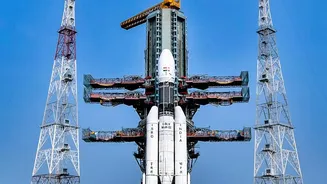
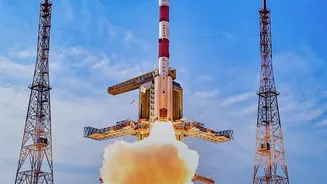
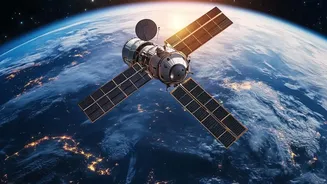
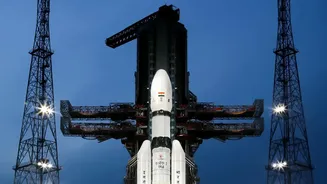
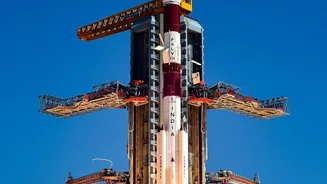
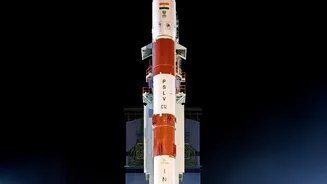
in September 2023, the Aditya-L1 mission is a landmark achievement for the Indian Space Research Organisation (ISRO). It is India's first dedicated space-based observatory for studying the Sun. The spacecraft is positioned at a unique spot 1.5 million kilometres from Earth, known as Lagrange Point 1 (L1). This vantage point allows it to watch the Sun continuously, without being blocked by the Earth or the Moon, providing an uninterrupted stream of data on solar activities. The mission's primary goal is to understand the Sun's behaviour, from its blistering outer layer, the corona, to the violent eruptions that can impact our planet. Aditya-L1 is equipped with seven advanced scientific instruments, each designed to observe a different aspect of our star.
What Are Solar Eruptions?
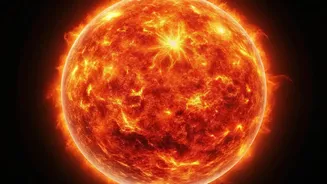
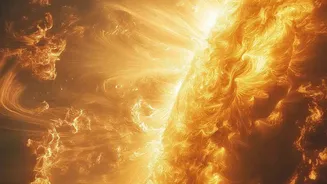
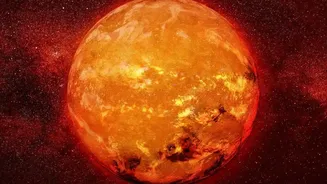
The Sun is not a calm, steady ball of fire. It's a dynamic and sometimes violent star that frequently releases enormous bursts of energy. The most powerful of these events are called Coronal Mass Ejections (CMEs). These are gigantic explosions of plasma—hot, electrically charged gas—and magnetic fields from the Sun's corona. When a CME is aimed at Earth, it can have serious consequences. These solar storms can disrupt our planet's magnetic field, potentially damaging satellites, knocking out communication networks and GPS, and even causing widespread power outages on the ground. Because of this, scientists are eager to improve 'space weather' forecasts, and that requires understanding not just that an eruption has happened, but exactly how it travels through space.
A Lopsided Discovery
For a long time, scientists have modelled CMEs as expanding symmetrically, like a perfect bubble growing larger as it moves away from the Sun. However, new findings from Aditya-L1 have challenged this idea. Scientists at the Indian Institute of Astrophysics (IIA) in Bengaluru analysed a CME that occurred on August 5, 2024. They discovered that the eruption did not expand uniformly. Instead, it grew asymmetrically, with different parts expanding at different rates. This lopsided expansion suggests our existing models of how CMEs travel might be too simple, a crucial detail that could change how we predict their journey and eventual impact.
How Aditya-L1 Saw the Unseen
This groundbreaking observation was made possible by one of Aditya_L1's key instruments: the Visible Emission Line Coronagraph (VELC). Unlike conventional telescopes that just take a picture, VELC is a coronagraph that blocks the Sun's blindingly bright disk to see the faint corona around it. More importantly, it performs spectroscopy, a technique that analyses the properties of light. By studying the light from the erupting plasma, VELC could measure its 'Doppler shift'. This allowed scientists to determine whether the gas was moving towards the spacecraft or away from it—a crucial third dimension of movement that images alone cannot capture. This capability, combined with images from NASA's Solar Dynamics Observatory and 3D modelling, allowed the IIA team to reconstruct the eruption's true, asymmetric shape.
Why an Asymmetrical Eruption Matters
Knowing that a CME can expand unevenly is more than just a scientific curiosity; it has major practical implications. The shape and expansion of a CME can affect its speed and how it interacts with the solar wind as it journeys through space. An asymmetrical eruption might experience different levels of drag, altering its path and speed in unpredictable ways. This makes forecasting its arrival time at Earth more challenging. Accurate predictions are vital for giving satellite operators, power grid managers, and airlines enough time to take protective measures. The discovery by Aditya_L1 provides critical data that will help refine our space weather models, leading to more reliable forecasts and better protection for our technology‑dependent society.