

Hubble’s Pointillist Masterpiece
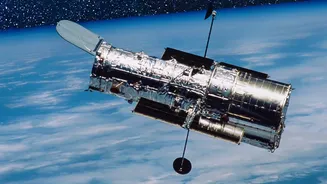
Since its launch in 1990, the Hubble Space Telescope has fundamentally changed our understanding of the universe. Its images of shimmering nebulae, distant galaxies, and the eerie deep fields are cultural touchstones. Hubble operates like a master artist
creating a detailed portrait, staring intently at a tiny patch of sky for hours or even days to capture faint, distant light. This 'soda straw' approach has been incredibly fruitful, allowing astronomers to calculate the age of the universe, confirm the existence of supermassive black holes, and study the atmospheres of planets outside our solar system. Its strength lies in its deep, narrow focus, observing in ultraviolet, visible, and near-infrared light to capture stunningly detailed close-ups of specific cosmic targets. In its more than 30 years of operation, it has observed countless objects, yet the total area of sky it has imaged is less than one percent.
Meet Roman: The Panoramic Surveyor
Enter the Nancy Grace Roman Space Telescope, NASA’s next-generation observatory set for launch by mid-2027. Named after NASA's first chief of astronomy, who was also known as the 'mother of Hubble', Roman represents a philosophical shift in space observation. It has a primary mirror that is 2.4 meters in diameter, the exact same size as Hubble's, meaning it can achieve the same crystal-clear image resolution. The critical difference, however, isn't the mirror but the camera behind it. Roman’s Wide Field Instrument (WFI) is an enormous, 300-megapixel camera designed not for staring, but for sweeping. This instrument gives Roman a field of view at least 100 times wider than Hubble’s infrared camera. Some estimates place it at over 200 times larger. This means a single snapshot from Roman can contain the detail of 100 Hubble images stitched together.
What a Wider View Unlocks
So, what does this massive increase in viewing area actually mean for science? It means a transition from studying individual objects to studying entire cosmic ecosystems. Roman's primary mission is to conduct vast surveys of the sky, a task for which Hubble is ill-suited. Over its five-year primary mission, Roman is expected to image more than 50 times the area of sky that Hubble has covered in over 30 years. This firehose of data will allow scientists to tackle some of the biggest mysteries in cosmology. Its main goals are to hunt for answers about dark energy, the mysterious force causing the universe's expansion to accelerate, and to map the distribution of invisible dark matter by observing its gravitational effects on millions of galaxies. It will also conduct a massive census of exoplanets using a technique called microlensing, which can detect planets down to the size of Mars, including free-floating 'rogue' planets not orbiting a star.
A Complementary Cosmic Toolkit
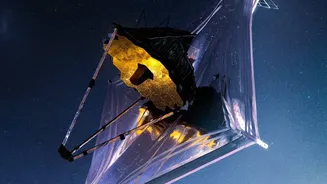
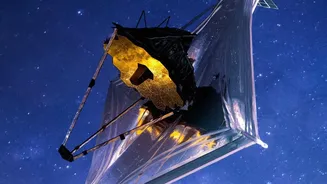
Roman is not a 'Hubble killer' or a replacement. Instead, it’s a powerful new tool that will work in tandem with Hubble and the James Webb Space Telescope (JWST). Think of it like a set of camera lenses: Roman is the wide-angle lens, capturing the sprawling landscape, while Hubble and Webb are the telephoto lenses, zooming in on fascinating details. Roman’s job is to be a scout. By rapidly mapping huge sections of the sky, it can identify rare and unusual objects—like rogue black holes or unique types of supernovae—that other telescopes would only find through sheer luck. Once Roman finds these targets, Hubble and Webb can perform deep, focused follow-up observations to understand their specific properties. Roman will generate enormous catalogs of stars, galaxies, and exoplanets, creating what scientists call a 'goldmine' of data for decades of future research.