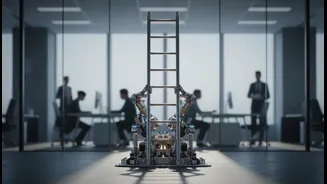








The Great AI Productivity Paradox
The promise of AI in the workplace is immense: automating repetitive tasks, uncovering deep insights from data, and freeing up employees for more strategic, creative work. Studies have shown significant productivity gains are possible. One report found
that access to AI assistance increased the productivity of customer support agents by 14%. Yet, for every success story, there are countless teams struggling with clunky new workflows and tools that don't quite fit. This gap between potential and reality is known as the productivity paradox. Many businesses are discovering that simply buying an AI tool doesn't guarantee results. In fact, without careful implementation, AI can lead to confusion, duplicated work, and frustrated employees who feel the new technology is just another box-ticking exercise that complicates their day.
When Managers Become the Bottleneck
The success or failure of AI adoption often hinges on the person sitting between the C-suite and the employees: the middle manager. They are responsible for translating broad company strategy into day-to-day action. However, managers can inadvertently sabotage the process in several ways. Some make the mistake of adopting AI without a clear goal, grabbing the latest trending tool without considering the specific problems their team needs to solve. Others fail to provide the necessary training or support, leaving employees to figure things out on their own. A common pitfall is using AI to avoid difficult but necessary leadership tasks, such as delivering constructive feedback, which can make leadership feel inauthentic and weaken team trust. When managers don't lead the change effectively, they become the primary bottleneck, and the investment in AI fails to deliver a return.
From Blocker to Enabler: Leading the AI Transition
So, what does good AI leadership look like at the managerial level? It's about shifting from a supervisor to a strategic enabler. This starts with setting a clear strategy and selecting use cases with a measurable return on investment. Instead of a blanket rollout, effective managers identify specific, time-consuming tasks within their team's workflow that are ripe for automation. They champion the change by leading by example and actively using the tools themselves. Most importantly, they make it a people-first transition. This involves open communication to address fears about job displacement, providing role-specific training, and creating a safe environment for experimentation. Employees who feel their manager supports AI use are nearly nine times more likely to report that it helps them perform better.
Redefining Work, Not Just Automating Tasks
The most visionary managers understand that AI isn't just about doing old tasks faster; it's about fundamentally redesigning work. Their role is evolving to orchestrate a hybrid team of people and AI systems. This requires a new set of skills: determining what should be automated, where human judgment remains critical, and how the two can collaborate to create new value. Rather than simply replacing human tasks, AI should augment them, freeing up cognitive space for more complex problem-solving and innovation. For managers in India's tech-forward economy, this presents a massive opportunity. By focusing on reskilling teams and redeploying talent into new, AI-augmented roles, they can move their organizations from being service providers to strategic innovation partners, driving not just efficiency but also growth.