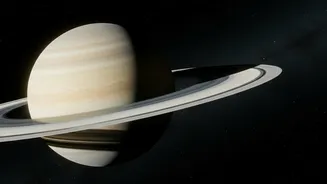

The Ghosts in the Rings
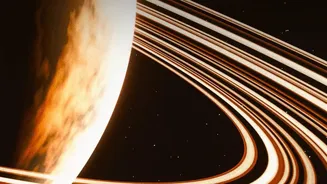
First spotted by NASA's Voyager 2 spacecraft in 1981, these transient phenomena are known as 'ring spokes'. They appear as dark, radial smudges across Saturn's B ring, stretching out like the spokes on a wheel. These are not permanent fixtures; they are incredibly
fleeting, often forming and dissipating within just a few hours. During active periods, new spokes continuously emerge, rotating with the rings for two or three orbits before vanishing completely. Though they seem small against the backdrop of the enormous planet, some spokes can stretch for thousands of kilometres, a length greater than the diameter of Earth.
A Seasonal Cosmic Puzzle
What makes these spokes so fascinating to scientists is their seasonal nature. Much like Earth, Saturn is tilted on its axis and experiences seasons, though each one lasts for about seven Earth years. The spokes don't appear randomly; they tend to show up in the years leading up to and following Saturn’s equinox, when the Sun is directly aligned with the planet's equator. They are most prominent around the time of the equinox and seem to disappear entirely during the planet's summer and winter solstices. This seasonal pattern has led scientists to believe the spokes are not caused by gravity, but by something else entirely.
An electrifying theory
The leading theory is that the spokes are connected to Saturn's powerful magnetic field. Scientists suspect that as Saturn approaches its equinox, the planet's rings are tilted in such a way that the solar wind—a stream of charged particles from the Sun—interacts more intensely with its magnetic field. This is thought to create a temporarily charged environment around the rings. This charge could cause tiny, dust-sized ice particles to levitate electrostatically, lifting them just above the larger ice boulders that make up the bulk of the rings. This cloud of elevated dust would then appear as a dark or light 'spoke', depending on the viewing angle. However, after decades of study, no single theory has perfectly explained their behaviour.
Hubble's Continued Watch
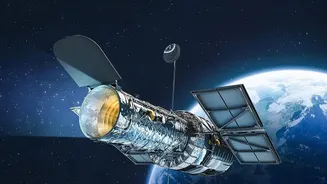
With NASA's Cassini mission—which provided incredible close-up views of the spokes during the last equinox in 2009—having ended in 2017, the task of monitoring these features has fallen to the Hubble Space Telescope. As part of its Outer Planets Atmospheres Legacy (OPAL) program, Hubble annually observes Saturn, building a long-term archive of data. Recent images captured by Hubble show 'spoke season' is now in full swing as Saturn heads towards its next autumnal equinox on May 6, 2025. Scientists like Amy Simon, lead of the OPAL program, note that they expect spoke activity to become even more frequent and prominent over the next few years. These fresh observations are crucial for tracking how the spokes form, evolve, and dissipate, offering the best chance yet to finally crack this long-standing planetary mystery.