





A Ghost Resurrected
Before McLaren became the globally recognized titan of Formula 1 and producer of hybrid hypercars, it was a small, gritty racing outfit founded by a brilliant New Zealander named Bruce McLaren. While many associate the brand's road car lineage with the iconic
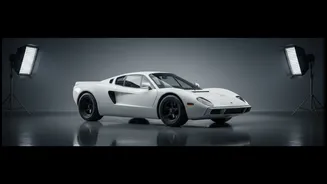
F1 of the 1990s, the dream started much earlier. The company's first road car project was the M6GT, a machine derived from the dominant Can-Am race cars of the late 1960s. Bruce McLaren himself used a prototype as his daily driver, but the project was tragically shelved after his untimely death in 1970. Now, decades later, McLaren's own bespoke division, McLaren Special Operations (MSO), has unveiled a stunning one-off recreation of the M6GT, a car built not just from parts, but from a forgotten ambition.
The Original Lost Idea
The "lost idea" was simple yet profound: to build the world's fastest and best-handling road car by adapting a dominant race car. In the late 1960s, McLaren's M6A racers were nearly unbeatable in the Can-Am series, a championship famous for its minimal rules and monstrously powerful cars. Bruce McLaren envisioned a coupe version, the M6GT, that would be eligible for sports car racing but also civil enough for the road. It was a radical concept, featuring a lightweight chassis, a thunderous mid-mounted Chevrolet V8, and dramatic bodywork with signature butterfly doors. Only a couple of prototypes were ever created before the program was halted, leaving the M6GT as a tantalizing 'what if' in automotive history.
From Archive Dust to Asphalt
This new M6GT is more than a replica; MSO calls it an 'authentic' recreation. The project was a labor of love and historical detective work. Technicians started with a genuine period M6A race car chassis, ensuring the soul of the car was authentic. They then unearthed the original body moulds and historic design drawings from the company's archives. Rather than modernizing the design, the team painstakingly recreated the car as Bruce McLaren would have known it, complete with a period-correct, small-block Chevrolet V8 and five-speed manual transmission. Every detail, from the hand-turned walnut gear knob to the specific type of aluminum rivets used, was chosen to be faithful to the original vision.
Modern McLaren vs. The Original Spirit
This resurrected M6GT stands in stark contrast to modern McLarens. Today's models, like the Artura or 750S, are technological marvels filled with hybrid systems, advanced aerodynamics, and sophisticated electronic driver aids. They are precise, incredibly fast, and digitally managed. The M6GT represents a different philosophy. It is raw, analog, and mechanical. Its reported top speed of over 265 km/h and a 0-160 km/h time of around eight seconds were astonishing for its era and remain respectable today. But its appeal lies not in raw numbers, but in the direct, unfiltered connection between driver, machine, and road—an experience that is the very essence of the lost idea it represents.
A Tribute in White and Green
The finished car is a rolling piece of history. It's finished in a special shade called Colnbrook White, a nod to the location of the factory where Bruce McLaren first developed his road car concepts. The white-over-green color scheme is a direct tribute to his very first Formula 1 car, the 1966 M2B, linking the brand's earliest racing efforts to its first road car dream. Debuting at the 2026 Goodwood Festival of Speed, a venue that holds deep significance as the circuit where Bruce McLaren tragically lost his life, the car is not for sale. It is a statement piece, a tangible link to the company's founder, and a reminder that the idea of a McLaren road car didn't start with the F1, but with a dream from the 1960s that has finally, beautifully, been fulfilled.