



An Ambitious Idea: Fertilizing the Ocean
The ocean is our planet's largest carbon sink, naturally absorbing a massive amount of CO2. The concept of ocean iron fertilization (OIF) aims to amplify this process. In vast regions of the ocean, especially the Southern Ocean, there are plenty of nutrients
for marine life, but a lack of one key micronutrient: iron. Adding small amounts of iron can trigger enormous blooms of phytoplankton, the microscopic plants at the base of the marine food web. Through photosynthesis, these blooms draw down huge quantities of atmospheric CO2. The hope is that when these phytoplankton die, they sink to the deep ocean, taking that carbon with them and locking it away for centuries.
New Study Maps Out the Consequences
While the basic principle is proven, the long-term effectiveness and ecological side effects have remained major questions. A new modelling study published in the journal Nature provides the most detailed assessment yet of these trade-offs. Researchers Jun Yu, Adam Martiny, and colleagues used an advanced ocean model to simulate over sixty years of fertilization data. Their findings confirmed that OIF could be a significant tool, potentially removing up to 0.70 gigatons of carbon dioxide per year. The most productive areas for this were identified as the Southern Ocean and the equatorial Pacific. However, the study also mapped out the significant downsides, providing a clearer picture of the ecological price tag attached to this climate intervention.
The Ecological 'Price Tag'
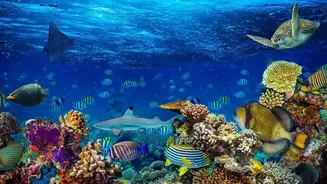
The study highlights a critical trade-off: where you fertilize matters immensely. Seeding the highly productive waters of the equatorial Pacific, for instance, could have severe downstream consequences. The model showed that doing so could lead to a significant decline in macrozooplankton biomass, the tiny animals that form a crucial link in the food chain. This happens because the explosive blooms deplete other essential nutrients in the water, effectively 'robbing' downstream ecosystems of the building blocks they need to thrive. Past research has also raised concerns that large-scale fertilization could create vast low-oxygen zones as the blooms decompose, harming marine life, and potentially even produce nitrous oxide, a greenhouse gas far more potent than CO2.
A Path to Safer Implementation?
The new research isn't just a warning; it also offers a potential path forward. The models showed that deploying iron fertilization in higher latitudes, such as the Southern Ocean, could dramatically reduce these negative ecological impacts while still achieving meaningful carbon removal. By choosing fertilization locations carefully, it may be possible to maximize the climate benefits while minimizing the harm to marine food webs. This shifts the conversation from a simple 'yes or no' on iron fertilization to a more nuanced discussion about 'where and how'. The findings provide a crucial framework for scientists and policymakers to weigh the regional risks and rewards, rather than treating the entire ocean as a single entity.
The Future of Ocean Carbon Removal
This study does not give a green light to immediately begin large-scale geoengineering. Rather, it underscores the immense complexity of interfering in Earth's natural systems. A growing consensus among scientists is that more research, including larger and longer-term field trials, is necessary before any deployment can be considered. These future experiments would need to rigorously monitor not just how much carbon sinks, but the full scope of ecosystem impacts, from phytoplankton composition to changes in oxygen levels. The recent modelling work is a vital step in designing those experiments responsibly, ensuring that any potential climate solution doesn't create an even bigger ecological problem.