
A Cosmic Weight-Gain Mystery
In the grand story of the universe, the first billion years after the Big Bang are a critical chapter. It was a time when the first stars and galaxies were lighting up the cosmos. But amidst this dawn, astronomers have found something perplexing: supermassive
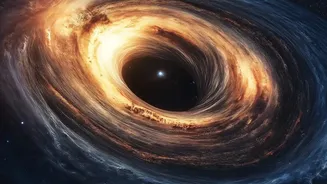
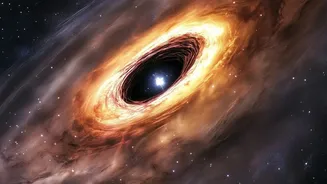
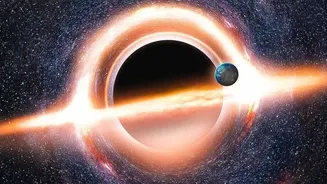
black holes (SMBHs) that are already billions of times the mass of our sun. Their existence poses a major problem for our understanding of cosmic evolution. Standard theories suggest that black holes grow by consuming gas, dust, and stars, but there simply wasn't enough time for them to grow so enormous so early in the universe's history. It's like finding a fully grown redwood tree just days after planting a seed. This mystery has sent scientists searching for alternative explanations, such as the existence of exceptionally massive 'seed' black holes or periods of extremely rapid growth.
Enter the 'Black Hole Star'
The latest clue comes from an object named MoM-BH-1, identified by researchers, including a team from MIT, using the James Webb Space Telescope (JWST). The name comes from the 'Mirage or Miracle' (MoM) survey that found it, and 'black hole star – one,' implying it's the first of its kind. What they found was a tiny, extremely bright red dot from just 660 million years after the Big Bang. At first, it displayed some characteristics of a star, but its energy output was 100 billion times greater than any known star could produce, something more akin to a feeding black hole. This led the team to a startling conclusion: they weren't looking at a star or a black hole, but a hybrid of the two—an object never directly observed before.
What Is MoM-BH-1?
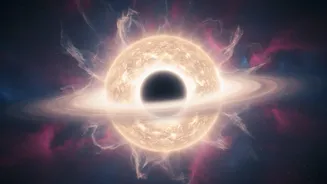
According to the model proposed by the research team, MoM-BH-1 consists of a central black hole about 100,000 times the mass of our sun. This 'seed' black hole is enveloped in a huge, dense cocoon of hydrogen gas roughly the size of our entire solar system. This gaseous cloak makes it appear somewhat like a star, but the immense energy is generated by the black hole at its core as it voraciously consumes the gas from the inside. This unique structure helps explain its bizarre properties, such as its extreme redness and a spectral signature known as a 'Balmer break' that is far deeper than any observed in ordinary stars. This suggests the gas is incredibly dense, providing the perfect conditions for a black hole to grow at an accelerated rate.
A 'Super-Eddington' Growth Spurt
This discovery provides strong evidence for a theoretical growth phase that could solve the early SMBH puzzle. The dense gas cloud surrounding the black hole allows it to feed at an extreme pace, potentially exceeding what is known as the 'Eddington limit'—the theoretical maximum speed at which a black hole can accrete matter before its own radiation pressure pushes the fuel away. This 'super-Eddington' accretion would allow the black hole to bulk up incredibly quickly, transforming a 100,000-solar-mass seed into a billion-solar-mass monster in a cosmically short period. MoM-BH-1, therefore, could be a snapshot of this crucial, super-charged growth phase that has long been predicted but never seen.
Connecting the 'Little Red Dots'
The discovery also sheds light on another JWST mystery: the prevalence of faint 'little red dots' scattered across the early universe. Researchers now suspect that many of these objects could be black hole stars similar to MoM-BH-1, but embedded within their host galaxies, which makes them harder to study individually. MoM-BH-1 is special because it appears to be 'naked,' with its light completely outshining any surrounding galaxy, giving astronomers a pure, unobstructed view of this new type of object. It's predicted that in about 100 million years, MoM-BH*-1 will merge with a nearby galaxy, and the resulting object would look very similar to the other little red dots. This suggests that the black hole star phase might be a common step in the evolution of all massive galaxies, including our own Milky Way.