




The Sun's Rhythmic Heartbeat
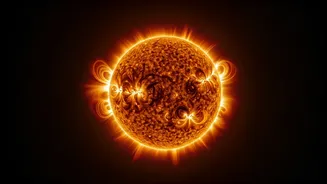
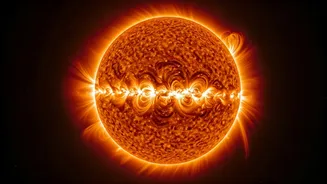
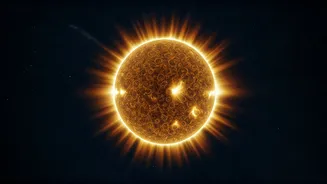
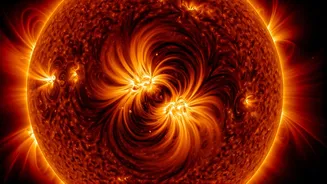
The sun isn't just a static ball of fire; it has a pulse. Roughly every 11 years, it goes through a solar cycle, moving from a period of low activity, known as solar minimum, to a peak of activity, called solar maximum, and back again. This rhythm is dictated
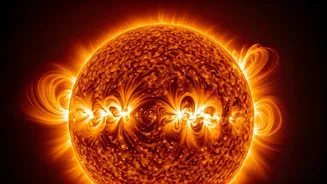
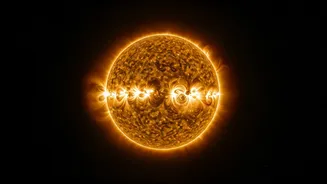
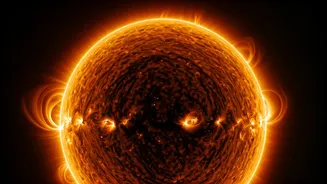
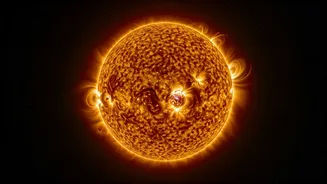
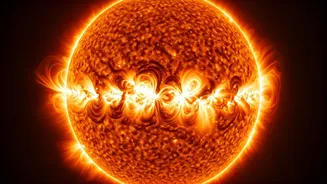
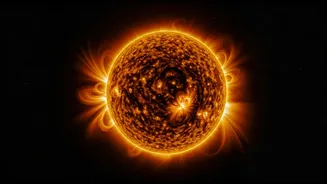
by the sun's complex and ever-shifting magnetic field. During solar maximum, the sun's surface is often dotted with sunspots, which are cooler, darker areas caused by intense magnetic fields. These active regions can erupt, launching powerful solar flares and vast clouds of solar material, known as coronal mass ejections (CMEs), into space. When directed at Earth, this 'space weather' can create beautiful auroras but also disrupt satellites, power grids, and communication systems. In contrast, a solar minimum is a period of relative calm, with very few sunspots.
What Is a Solar Hibernation?
A 'solar hibernation,' more formally known as a Grand Solar Minimum, is a multi-decade period where sunspot activity drops dramatically. The most famous example is the Maunder Minimum, which occurred from roughly 1645 to 1715. During this time, astronomers observed extremely few sunspots, sometimes for years on end. This period coincided with the middle part of the 'Little Ice Age,' a time of cooler temperatures in parts of the Northern Hemisphere, which saw rivers like the Thames in London freeze over. While it's tempting to draw a direct line between the two, scientists are cautious. The Little Ice Age began before the Maunder Minimum and was likely caused by multiple factors, including increased volcanic activity. The sun's reduced output probably contributed to the cooling, but it wasn't the sole driver.
Why Predicting a Hibernation Matters
If a grand minimum were to happen today, it would not trigger another ice age or reverse the effects of human-caused climate change. Scientific consensus suggests that a prolonged solar minimum would only lead to a slight cooling of about 0.3 degrees Celsius at most, a small dent in the overall warming trend. However, predicting such an event is still crucial. A weaker sun means a weaker solar magnetic field, which acts as a shield for our solar system. This would allow more high-energy galactic cosmic rays from deep space to reach Earth's vicinity. This could have several potential effects, including a possible influence on cloud formation and weather patterns, and increased radiation risks for astronauts in space and for satellites operating outside Earth's protective magnetic field. Understanding these long-term solar cycles is vital for our increasingly space-dependent society.
The Hunt for Early Warnings
To predict a future hibernation, scientists are studying the sun's inner workings, looking for clues in the deep currents of plasma that generate its magnetic field—a process known as the solar dynamo. One key indicator they track is the 'rush to the poles,' a flow of magnetic remnants from old sunspots. Another is the behavior of large-scale plasma flows called torsional oscillations, which can herald the arrival of a new solar cycle. Some studies have suggested that a weakening of the sun's polar magnetic fields or the absence of these precursor flows could signal an impending grand minimum. However, this is a young and evolving field of science. While some models based on past cycles have suggested a weakening trend, the sun often defies simple predictions.
The Verdict: Are We Close to a Prediction?
So, is a solar hibernation on the horizon? The short answer is: it's unlikely anytime soon. Predictions in the late 2010s suggested that the current cycle, Solar Cycle 25, would be weak, similar to the previous one, potentially heralding a slide towards a minimum. However, Solar Cycle 25, which began in December 2019, has been surprisingly active, consistently outperforming forecasts. This solar vigour has quieted much of the talk about an imminent grand minimum. Scientists are now incorporating this new data to refine their models of the solar dynamo. While they can now see the very early magnetic stirrings of the next cycle, Solar Cycle 26, predicting its strength—let alone a decades-long hibernation—remains a formidable challenge. The sun still holds many of its secrets close.