


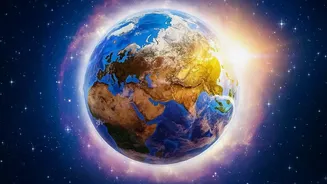

The Planet’s Slow-Motion Dance
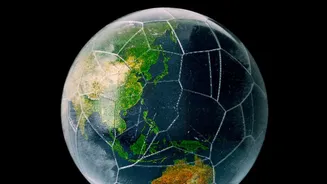
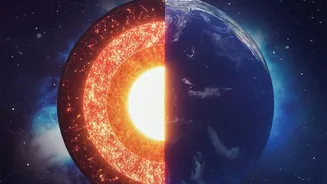
The ground beneath our feet feels solid, but on a geological timescale, it’s anything but. Earth's crust is broken into massive tectonic plates that float on the semi-molten mantle below. Driven by immense heat rising from the planet's core, these plates are
constantly in motion, drifting at roughly the same speed your fingernails grow. This perpetual movement is the engine of what scientists call the supercontinent cycle. Roughly every 300 to 600 million years, these wandering continents collide and merge into a single, enormous landmass. This process is responsible for creating massive mountain ranges, influencing climate, and steering the course of evolution. But no supercontinent lasts forever. The immense landmass acts like a giant blanket, trapping mantle heat. Eventually, this trapped energy causes the supercontinent to bulge, crack, and rift apart, sending the continents on their separate ways once more, only to begin the slow dance of reunification all over again.
Meet the Ancestors: Rodinia and Columbia
Long before Pangea became the poster child for ancient geography, other titans dominated the globe. To find them, we have to look deep into the geological record. Scientists use paleomagnetism—the study of ancient magnetic fields locked in rocks—along with fossil evidence to piece together the planet's past. One of the most well-understood predecessors to Pangea is Rodinia, which came together about 1.2 billion years ago. It’s thought to have been a stark, alien world, possibly triggering a planet-wide ice age known as "Snowball Earth" before it began to break apart around 750 million years ago. Before Rodinia, there was Columbia (also known as Nuna), which existed from about 2.1 to 1.8 billion years ago. Piecing together these ancient landmasses is a scientific puzzle. The evidence erodes over eons, but clues remain in the form of ancient mountain belts and rock formations that match across continents now separated by vast oceans.
Pangea: The Most Famous Predecessor
Pangea is the supercontinent we all learn about in school. It formed around 335 million years ago and created a world unlike anything we know today. A single, colossal ocean called Panthalassa surrounded it. The interior of Pangea was likely an immense, arid desert due to its sheer distance from oceanic moisture, while coastal regions were battered by mega-monsoons. Its formation mashed continents together, creating mountain ranges like the Appalachians in North America. Pangea’s reign saw the rise of the dinosaurs, but the same forces that built it also tore it apart. Around 200 million years ago, rifting began, eventually opening the Atlantic Ocean and splitting Pangea into Laurasia in the north and Gondwana in the south, which themselves continued to fragment into the continents we recognize today.
The Next Chapter: Amasia
So, if the cycle continues, what’s next? Geologists are already looking ahead, running supercomputer simulations to predict the next supercontinent. While there are a few competing theories, a leading candidate is Amasia. This future landmass is predicted to form in the next 200 to 300 million years as the Americas and Asia-Australia drift north and collide, closing the Arctic and Pacific Oceans. One model suggests that the Americas will continue their westward drift, eventually crushing the Pacific Ocean—which is currently shrinking—and fusing with Asia. The Atlantic, in this scenario, would become the world’s new superocean. The world of Amasia would be drastically different, with lower sea levels and a vast, arid interior marked by extreme temperature swings.