




A Ghost in the Ice
In September 2021, a sensor buried deep within the Antarctic ice sheet registered a fleeting flash of light. This wasn't just any signal; it was the signature of a high-energy neutrino, an elusive subatomic particle often called a 'ghost particle'. Trillions
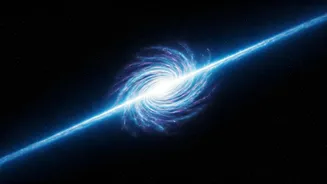
of these pass through our bodies every second, rarely interacting with matter, which makes them almost impossible to trace. But this one was different. Detected by the IceCube Neutrino Observatory, a massive telescope made of ice, this particle carried immense energy, suggesting it was born in a violent cosmic event far across the universe. Because neutrinos travel in a straight line, undeflected by magnetic fields, this detection gave astronomers a direction—a tiny patch of sky to search for a source. The hunt was on.
The Search for a Source
Immediately, astronomers around the world pointed their telescopes toward the region of sky the neutrino had come from, searching for a likely culprit. They were looking for the usual suspects: an exploding star (supernova), a flare from a supermassive black hole, or a gamma-ray burst. But they found nothing. The sky was unusually quiet. The mystery deepened. An international team of scientists, however, decided to look at the universe in a different light—not with optical telescopes, but with instruments that detect longer wavelengths, like those captured by the Atacama Large Millimeter/submillimeter Array (ALMA). There, hidden from visible sight, they found it: an object that wasn't just bright, but furiously energetic.
Meet the Shadow Blaster
The object, officially catalogued as JCMT0402−0424, was so remarkable that it quickly earned a nickname: the Shadow Blaster. The name captures its dual nature perfectly. It is a 'shadow' because it is shrouded in such a thick veil of cosmic dust that it’s nearly invisible to traditional optical telescopes. But it is also a 'blaster' because at submillimeter wavelengths, it blazes with the light of nearly 2.7 trillion suns. It is an object of immense power, hiding in plain sight. This combination of being hidden yet powerful is precisely why it was the perfect candidate for the source of the mysterious ghost particle. The particle could escape the dense, dusty galaxy while the light could not.
A Cosmic Star Factory
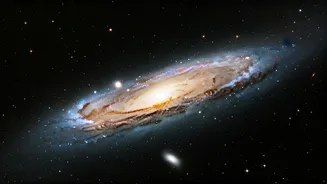
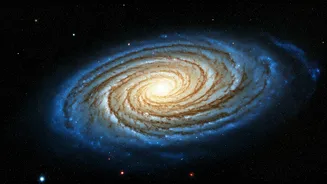
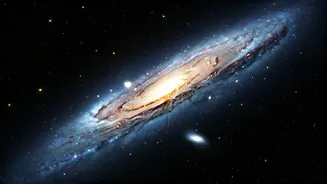
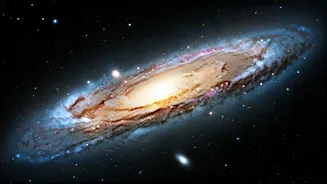
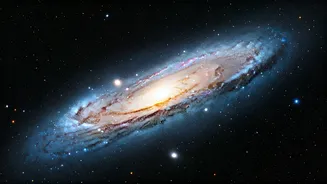
What makes the Shadow Blaster truly special is not just its power, but the source of that power. Until now, the few cosmic objects successfully linked to high-energy neutrinos were 'active galaxies' or 'quasars'—galaxies with furiously active supermassive black holes at their centers. Astronomers expected to find the same here. But detailed observations revealed no sign of a central black hole driving the activity. Instead, the Shadow Blaster is a 'starburst galaxy'. It is a cosmic factory going into overdrive, churning out new stars at a rate hundreds of times faster than our own Milky Way. The immense energy comes from the collective power of millions of young, massive stars being born and dying in a spectacular frenzy. This discovery provided the first strong evidence that starburst galaxies, not just black holes, can be powerful particle accelerators.
A Helping Hand from Einstein
Studying a galaxy 11 billion light-years away in such detail would have been impossible on its own. But astronomers had a secret weapon, courtesy of Albert Einstein's theory of general relativity. By a fortunate cosmic alignment, another massive galaxy sits directly between Earth and the Shadow Blaster. The immense gravity of this foreground galaxy acts as a natural magnifying glass, bending and amplifying the light from the Shadow Blaster behind it. This phenomenon, known as gravitational lensing, split the view of the distant galaxy into four distorted but magnified images, giving scientists a much clearer look at its inner workings than would have otherwise been possible. It was this cosmic telescope that allowed them to confirm it was a starburst galaxy.