


A New Surveyor for the Cosmos
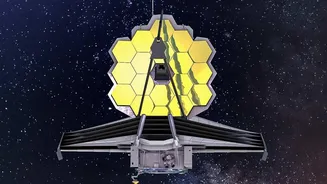
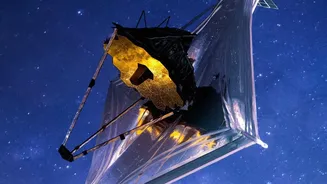
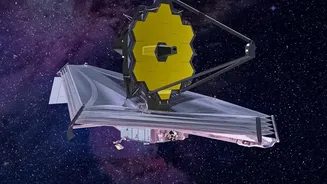
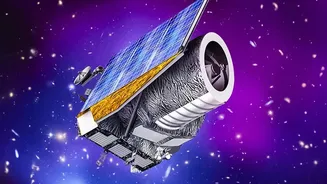
Launched in August 2026, the Nancy Grace Roman Space Telescope is NASA's next great observatory, named after the agency's first chief of astronomy. While the Hubble and James Webb space telescopes are designed to look deep into small patches of sky with
incredible detail, Roman is built for breadth. Its primary mirror is the same size as Hubble's, but its Wide Field Instrument gives it a field of view 100 times larger. Imagine looking at the night sky through a straw, and then switching to a panoramic window—that's the leap Roman represents. This vast perspective will allow it to map huge sections of the galaxy with incredible speed, creating an unprecedented census of cosmic objects. While its mission includes studying the mysteries of dark energy and galaxy evolution, one of its most exciting goals is a massive search for exoplanets.
Seeing Worlds Through Warped Spacetime
Roman will primarily hunt for exoplanets using a technique called gravitational microlensing. This method relies on a prediction from Albert Einstein's theory of general relativity: gravity bends light. When a star passes in front of a more distant star from our point of view, its gravity acts like a natural magnifying glass, briefly making the background star appear brighter. If that foreground star has a planet, the planet’s own smaller gravity creates an additional, shorter blip in the brightness. By monitoring hundreds of millions of stars for these telltale signatures, Roman will be able to detect planets without ever seeing them directly. This technique is especially powerful for finding planets that are difficult to spot with other methods, such as those on wide orbits far from their star or even 'rogue' planets that drift through space without a stellar companion. Scientists anticipate finding thousands of new worlds this way, including planets with masses similar to Earth's.
Creating an Artificial Eclipse in Space
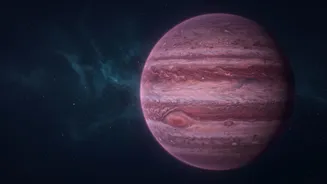
Roman's second tool for exoplanet science is a groundbreaking piece of technology called a Coronagraph Instrument. Trying to take a picture of a planet next to its star is like trying to spot a firefly next to a searchlight. The star's overwhelming glare washes everything out. A coronagraph works like a sophisticated internal sunshade, using a system of masks and mirrors to block the starlight and reveal the much fainter light of an orbiting planet. Roman's coronagraph is a technology demonstration, designed to be 100 to 1,000 times more powerful than any previous coronagraph flown in space. It features deformable mirrors that actively adjust their shape in real-time to cancel out stray starlight, allowing for the direct imaging of Jupiter-sized planets around nearby stars. This will not only provide actual pictures of these worlds but also allow scientists to analyze the light from their atmospheres to learn about their composition.
A New Partner for Hubble and Webb
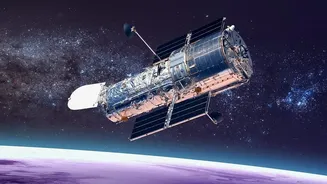
Roman isn’t a replacement for Hubble or Webb, but a powerful new partner. The three telescopes work together to provide a more complete picture of the cosmos. Hubble provides sharp, detailed views; Webb peers deep into the universe's past; and Roman acts as the wide-angle surveyor, finding interesting targets and providing statistical context. Roman is expected to find tens of thousands of transiting planets—in addition to its microlensing discoveries—creating a massive catalog of worlds. The most intriguing of these can then be studied in greater detail by Webb, which can analyze their atmospheres with unparalleled precision. By combining Roman's wide-angle survey with Webb's deep stares, astronomers will be able to answer fundamental questions about how planetary systems form and how common planets like our own truly are.