






A Look Beneath the Lava
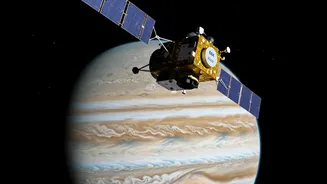
In a groundbreaking first, NASA's Juno spacecraft has successfully measured temperatures below the surface of Io, the most volcanically active body in our solar system. During close flybys in late 2023 and early 2024, Juno used its Microwave Radiometer
(MWR) to probe two to six metres beneath the moon's crust. The findings were startling: everywhere scientists looked, the temperature rose by more than 22 degrees Celsius just a few feet down. This sharp temperature increase is far more than could be explained by sunlight alone, confirming that significant heat is rising from within Io's interior.
An Unexpected Discovery Tool
The instrument behind this discovery, the Microwave Radiometer, was originally designed to peer deep into Jupiter's thick cloud tops. Scientists on the Juno mission ingeniously repurposed it to study Jupiter's moons. While infrared instruments can only read the temperature of a planet's outermost skin, the MWR can sense thermal emissions at various depths. The ability to use this instrument to see below the solid, rocky surface of Io was an unexpected but welcome surprise for the science team. It has opened up a new way to study how heat moves through planetary crusts, not just on Io but potentially on other worlds, including Earth.
The Solar System's Volcanic Heart
Io's extreme volcanism, with over 400 active volcanoes, is driven by a process called tidal heating. The moon is constantly stretched and squeezed by the immense gravity of Jupiter, as well as the gravitational pull of fellow moons Europa and Ganymede. This relentless tug-of-war generates tremendous friction and heat inside Io, causing its surface to bulge up and down by as much as 100 metres. Until now, scientists could only observe this heat as it escaped from surface lava flows and volcanic plumes. These new subsurface readings provide the first direct evidence of how that heat is moving on its way to the surface.
Rewriting the Geologic Models
The new data presents two main possibilities for how Io's heat is transferred. The heat may be rising steadily through a conductive crust, or it could be escaping through patches of thin crust covering cooling lava flows. The readings also contained another surprise: despite its violent volcanic activity, large parts of Io's surface are remarkably smooth when viewed in microwave wavelengths. The top layer appears to have a low density, similar to pumice or volcanic ash, rather than solid rock. This suggests the moon is constantly being repaved with a fluffy layer of eruptive debris that buries older terrain.
What This Means for Future Exploration
These findings have profound implications beyond just Io. Understanding the mechanics of tidal heating on this extreme world provides a window into a fundamental process that shapes worlds across the cosmos. It fuels not only Io's volcanoes but also the potential subsurface oceans on icy moons like Europa and Ganymede, which are prime targets in the search for life. Furthermore, the success of the MWR instrument demonstrates a new technique that could be used to study volcanic activity on Earth, potentially offering new ways to understand how our own planet's volcanoes work. This breakthrough provides the clearest picture yet of the engine driving Io's geological activity and will guide future research into fiery and icy worlds alike.