



Why Practice for the Moon Underwater?
At first glance, training for a lunar mission at the bottom of the sea seems counterintuitive. However, these aquatic missions are a core part of NASA's 'analog' training, which uses extreme environments on Earth to simulate conditions on other worlds.
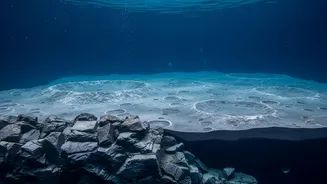
The primary benefit of being underwater is achieving neutral buoyancy. By carefully weighting the astronauts and their equipment, trainers can simulate the Moon's one-sixth gravity, allowing crews to practice moving, handling tools, and conducting long, complex tasks as they would on the lunar surface. These simulations take place in facilities like NASA's Neutral Buoyancy Laboratory (NBL) in Houston, a massive indoor pool, and the Aquarius Reef Base off the coast of Florida, the world's only undersea research laboratory. For days or even weeks at a time, crews live and work in this isolated, high-pressure environment, which mimics the psychological and physical demands of a real space mission.
Rehearsing for a New Lunar Frontier
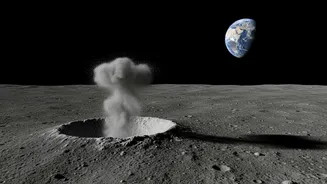
NASA's Artemis program isn't just a return to the Moon; it's an expedition to a new, largely unexplored region: the South Pole. Unlike the equatorial regions visited during the Apollo missions, the South Pole is a land of extremes. The Sun hangs low on the horizon, casting long, dark shadows that can obscure the landscape and make geological work treacherous. Some craters in this region are permanently shadowed, meaning they haven't seen sunlight in billions of years and could contain water ice. These underwater tests allow NASA to specifically address these challenges. Recent training sessions have focused on recreating the low-angle lighting conditions of the South Pole. This helps teams test lighting setups on spacesuits and rovers, develop strategies for navigating in deep shadows, and determine how to best identify rock and soil samples when visual information is limited. It's a dress rehearsal for science in one of the most difficult environments in the solar system.
The Science of a Spacewalk
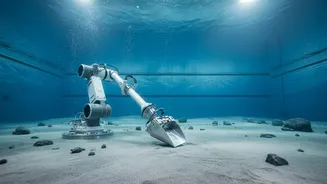
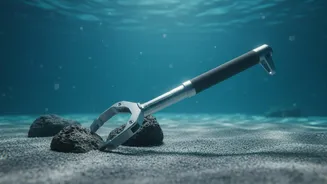
The upcoming Artemis missions are not just about planting a flag; they are sophisticated scientific expeditions. Astronauts will function as field geologists, and their ability to perform complex scientific tasks is paramount. Underwater training allows them to practice the specific skills they'll need. During recent tests, geologists donned prototype spacesuits to test geology tools and techniques on a simulated lunar landscape built on the pool floor. They practiced everything from kneeling and collecting samples with drills, scoops, and chisels to documenting their findings in real-time. A key goal is to build 'muscle memory' for these tasks, so when an astronaut is on the Moon with limited time and high operational demands, their scientific training takes over. They learn how to efficiently identify promising samples, preserve them without contamination, and communicate their observations effectively to the science teams back on Earth.
From the Ocean Floor to the Lunar Surface
The lessons learned during these analog missions, known as NASA Extreme Environment Mission Operations (NEEMO), are invaluable. They go far beyond just astronaut training. The missions serve as a testbed for developing new technologies, from heads-up displays inside helmets to innovative sample collection tools. They also allow NASA to refine operational concepts, such as how an intravehicular crew member inside the habitat can best support the 'spacewalking' scientists outside. Communication delays, like those that will be experienced between the Moon and Earth, are also simulated to test crew autonomy and decision-making. Every procedure tested and every piece of hardware validated in the controlled, yet challenging, underwater environment reduces the risk and increases the potential scientific return for the actual Artemis missions. This meticulous preparation ensures that when humans next set foot on the Moon, they are not just visitors, but highly effective planetary scientists ready to unlock its secrets.