






An Unexpected Ice Gain
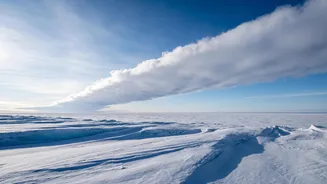
Scientists have found that between 2021 and 2023, East Antarctica experienced a period of exceptionally heavy snowfall, leading to a temporary net ice sheet mass gain of about 695 billion tons. This is a significant anomaly, especially when considering
that for the past two decades, Antarctica has been losing ice at an alarming rate, averaging a loss of about 140.5 billion tons per year. This recent gain, detailed in a study published in the journal Nature, marks the largest short-term ice increase ever observed by the GRACE satellite missions, which have been monitoring the continent's mass since the early 2000s. The surge in mass was concentrated in the East Antarctic Ice Sheet, a region generally considered more stable than its western counterpart.
A Tropical Connection
The cause of this immense snowfall wasn't a sudden polar chill, but rather a warming event happening thousands of kilometres away. Researchers discovered that a persistent patch of unusually warm ocean water in the tropical warm pool — where the western Pacific and eastern Indian Oceans meet — was the culprit. This distant warming triggered a chain reaction in the atmosphere, altering circulation patterns and funnelling vast amounts of moisture toward East Antarctica. This process, which included the formation of more 'atmospheric rivers', resulted in sustained, heavy snowfall across regions like Queen Mary Land and Wilkes Land. The study highlights a profound and unexpected teleconnection, demonstrating how conditions in the tropics can directly influence the climate of the world's most remote continent.
Not a Reversal of Fortune
While a 695-billion-ton ice gain sounds like fantastic news, scientists are quick to caution that this does not signal a reversal of Antarctica's long-term decline. The gain is temporary and regional. The West Antarctic Ice Sheet, home to the notoriously unstable Thwaites and Pine Island glaciers, continues to lose mass at a worrying pace due to warm ocean waters melting it from below. This new snowfall in the East only managed to temporarily slow the continent's overall contribution to sea-level rise; it did not stop or reverse it. In fact, the long-term trend of ice loss from Antarctica as a whole remains a primary driver of rising global sea levels.
Why This Matters for India
The fate of Antarctica's ice may seem like a distant problem, but it has direct and severe implications for India. With over 7,500 kilometres of coastline, India is acutely vulnerable to sea-level rise. The stability of the Antarctic ice sheets, which hold enough water to raise global sea levels by many metres, is a critical factor in the future safety of coastal megacities like Mumbai, Chennai, and Kolkata. While the recent snowfall in East Antarctica provided a small, temporary buffer, the continued and accelerating melt in West Antarctica remains a significant threat. Understanding these complex climate dynamics, such as the newly discovered link between tropical oceans and polar snowfall, is crucial for refining climate models and accurately projecting future sea-level rise, allowing coastal communities in India and around the world to prepare for the changes to come.