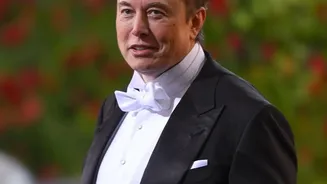







Elon Musk, a man known for launching rockets and electric cars, has a new target in his sights: a humble piece of punctuation. His recent proposal to alter the long dash has ignited a fiery—and surprisingly passionate—debate online.
The Post That Launched a Debate
It all started, as
it so often does, with a post on X. Responding to another user's comment, Musk took aim not at the substance of the post, but at its punctuation. He suggested that the 'rules of English need to change', specifically targeting the em dash (—), also known as the long dash. His critique was twofold: that the em dash is 'unpleasantly long' and that its use without spaces makes it resemble a hyphenated word rather than a break in thought. He proposed that the shorter en dash (–) is a 'better length' and that spaces should be used around it to signify a parenthetical phrase. This wasn't a formal policy announcement, but on a platform he owns, Musk's musings carry significant weight, effectively turning a style preference into a potential rule change for millions of users.
A Crash Course on Dashes
For those whose grammar lessons are a distant memory, the controversy might seem baffling. What exactly is an em dash, and how does it differ from its shorter cousins? The hyphen (-) is the shortest, used to join words together, like in 'state-of-the-art'. The en dash (–), roughly the width of the letter 'N', is primarily used to indicate a range, such as 'pages 10–20' or '2022–2026'. Then there is the em dash (—), the longest of the three and the subject of Musk's critique. Named because it's about the width of the letter 'M', the em dash is a versatile and powerful tool. Writers use it to create a dramatic pause, set off an explanatory clause, or show an abrupt change in thought—much like this very sentence. It can often be used in place of commas, colons, or parentheses to add emphasis or a specific stylistic flair.
The Great Dash Divide
The reaction to Musk's suggestion was swift and passionate, revealing a deep divide in the world of words. Many writers, editors, and grammar aficionados rushed to the em dash's defense. They argued that it provides a unique rhythm and voice, allowing for a more conversational and emphatic tone that other punctuation marks can't replicate. For its fans, the em dash is a sophisticated tool for crafting complex sentences and conveying nuance. However, others sided with Musk, arguing that the em dash is often overused and pretentious, a hallmark of writing that tries too hard to sound important. Critics also point out that its use has exploded in the age of AI, with language models frequently inserting em dashes, sometimes incorrectly, making text feel generic and formulaic. In this view, Musk's push for a simpler alternative is a move toward clarity and away from stylistic clutter.
Platforms, Punctuation, and Power
Beyond the merits of one punctuation mark over another, the debate highlights a broader trend: the power of tech platforms and their leaders to shape how we communicate. Language has always evolved, but that evolution is now influenced by algorithms, user interface designs, and the stylistic whims of tech billionaires. Musk's 'proposal' isn't just about grammar; it's about the centralized control over digital expression. If X were to programmatically change how dashes are rendered, it would instantly alter the writing style of millions of people. This incident serves as a potent reminder that the digital spaces where we spend so much time are not neutral public squares; they are governed environments where the rules—right down to the length of a dash—can be rewritten from the top down.