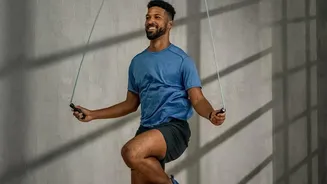







The Need for Speed: Jump Rope's Edge
When it comes to boosting foot speed, agility, and raw explosiveness, the jump rope is an undisputed champion. Its power lies in a principle called plyometrics. Every skip is a small, rapid jump that trains your muscles to contract and release at high
speed. This process, known as the stretch-shortening cycle, essentially teaches your lower-leg muscles and tendons to act like coiled springs, storing and releasing energy more efficiently. The constant, low-impact bouncing on the balls of your feet strengthens calves, improves coordination, and fine-tunes the neuromuscular pathways that allow your brain to tell your feet to move faster. Over time, this translates into quicker directional changes on the court, a faster cadence on a run, and a generally lighter, more reactive feeling in your feet.
The Foundation: Where Yoga Fits In
While jump rope builds the engine for speed, mindful yoga flows build the chassis that can handle the power. Speed without stability and control is a recipe for injury. Yoga excels at developing the often-overlooked components of athleticism: balance, flexibility, and proprioception—your body's awareness of its position in space. Poses like Tree Pose and Warrior III challenge you to balance on one leg, forcing the tiny stabilizing muscles in your feet and ankles to fire constantly. This creates incredible stability and strength from the ground up. The constant wobbling and micro-adjustments you make while holding a balancing pose are actively strengthening your ankles against sprains and rolls. Furthermore, flows that stretch the hips, hamstrings, and calves increase your overall range of motion, allowing for a more fluid and efficient stride.
Power vs. Poise: A Shared Goal
It’s tempting to pit the high-octane cardio of jumping rope against the deliberate stillness of holding a yoga pose, but they share a crucial objective: enhancing the mind-body connection. Jump rope forges this link through rhythm and timing, demanding your full concentration to coordinate your hands and feet in a rapid, repetitive motion. A single lapse in focus results in a tangled rope and a broken rhythm. Yoga, on the other hand, cultivates this connection through breath and introspection. Holding a challenging pose requires you to breathe through discomfort and pay close attention to subtle shifts in your body. Both disciplines train your nervous system to be more responsive and your body to move with greater precision, whether that movement is an explosive leap or a subtle adjustment to maintain balance.
Crafting Your Perfect Routine
The most effective fitness plan isn't a matter of choosing one activity over the other, but of understanding how to integrate them for a synergistic effect. Think of jump rope and yoga as complementary tools in your athletic toolkit. Use the jump rope as a dynamic warm-up to prime your nervous system before a workout or as a high-intensity interval training (HIIT) session on its own. Just 10-15 minutes of focused jump rope work two or three times a week can yield significant gains in foot speed and cardiovascular endurance. Reserve yoga for your cool-down, recovery days, or as a dedicated practice to improve mobility and mental focus. A slower-paced yoga session can help lengthen muscles post-workout, reducing soreness and improving flexibility, while a more active flow can serve as a low-impact workout that still builds strength and stability.