





The 'Gigafactory of Compute'
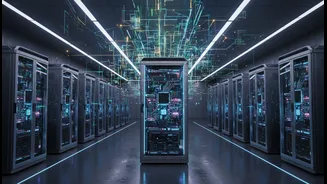
At the heart of this strategy is a colossal project from Elon Musk's AI company, xAI, which has deep ties to SpaceX. Musk has announced plans to build a "Gigafactory of Compute," a massive supercomputer designed to power the next generation of artificial
intelligence. Initial plans detailed a machine containing 100,000 of Nvidia's highly sought-after H100 graphics processing units (GPUs), with the goal of being operational by late 2025. This isn't just about building a powerful machine for its own AI chatbot, Grok; it’s about creating an asset of such immense scale that it becomes a strategic tool in the entire AI ecosystem. The name intentionally echoes Tesla's Gigafactories, which were built to achieve dominance through massive scale and production efficiency.
Picks and Shovels in a Gold Rush
The core strategic question is: why lease the tools instead of just selling the gold? In the current AI boom, access to raw computing power is a major bottleneck. Companies across the globe are scrambling for the specialized GPUs needed to train and run large AI models. By leasing access to its supercomputer, Musk's enterprise would be adopting a classic "picks and shovels" business model. Instead of relying solely on the success of its own AI model, Grok, it can generate massive, recurring revenue by selling the essential infrastructure that all AI developers need. It's a way to monetize a massive capital investment directly and capitalize on the entire industry's growth, not just its own corner of it.
A New Cloud War Competitor
This strategy positions Musk's ventures as a direct competitor to the established giants of cloud computing: Amazon Web Services (AWS), Microsoft Azure, and Google Cloud. These companies have built empires by providing on-demand computing infrastructure. However, recent developments show this isn't just a plan; it's happening. In June 2026, reports emerged that Google itself signed a deal to lease AI compute capacity from SpaceX for a reported $920 million per month to meet surging demand for its own Gemini platform. Another AI leader, Anthropic, also reportedly signed a multi-billion dollar agreement to lease capacity from an xAI supercomputer. These deals validate the leasing model and prove that even the biggest players are hungry for more capacity.
Flexibility and a Grand Vision
While leasing provides revenue, the company is also building in flexibility. Musk has clarified that at least one of the major leasing deals includes clauses allowing SpaceX to reclaim the computing capacity if its own internal needs become "super tight." This highlights the dual nature of the strategy: generate revenue now, but preserve the hardware for a future where its own AI ambitions may require every available processor. This hardware is central to the synergy across Musk's companies. The supercomputer trains xAI's Grok using data from X (formerly Twitter). The resulting AI could eventually be used in Tesla's self-driving and robotics efforts, as well as for complex orbital mechanics and autonomous systems at SpaceX. Starlink, SpaceX's satellite internet service, provides the global connectivity backbone to tie it all together.
From Hardware to a Revenue Machine
The pivot to leasing compute power has already begun to transform the financial outlook for Musk's AI and space ventures. What would otherwise be a depreciating capital asset—a massive, expensive computer—is being turned into a multi-billion dollar recurring revenue stream. Deals with major players like Google and Anthropic could generate tens of billions in annual revenue, fundamentally reshaping the business model. This strategy also serves another purpose: proving a powerful business case ahead of a potential IPO for the newly intertwined ventures. By turning idle hardware into a highly profitable service, the company is demonstrating its ability to create value from every part of the AI stack, from infrastructure to application.