

A Galactic Anomaly
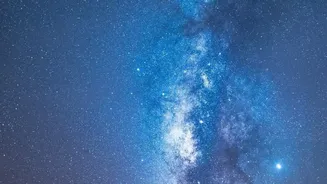
For years, astronomers have been puzzled by a particular feature of the Milky Way. While the main disc of the galaxy, containing our sun and most of the stars we see, spins rapidly, the vast, sparse cloud of stars surrounding it—the stellar halo—barely
rotates at all. Data from the European Space Agency's Gaia mission confirmed this strange sluggishness, but the reason behind it remained a mystery. Why would one part of the galaxy be racing along while its outer region was practically standing still? This discrepancy suggested a piece of our galaxy's history was missing.
Clues in a Computer
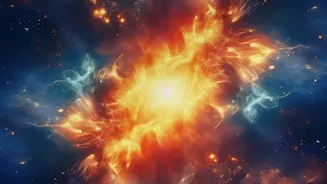
To solve this puzzle, astronomers at Durham University turned to supercomputer simulations. They created and evolved 25 virtual galaxies similar to our own, watching them develop over billions of years. A clear pattern emerged: the simulated galaxies that ended up with slow-rotating stellar halos all shared two key events in their past. First, they had undergone a massive, head-on collision with another galaxy. Second, their entire galactic disc had performed a 'disc flip,' tumbling and reorienting itself by more than 90 degrees. The research, presented at the Royal Astronomical Society's National Astronomy Meeting, provided a powerful new theory.
The Smoking Gun Collision
This simulation-based theory is compelling because we already have strong evidence for the first condition. Astronomers know that about 10 to 11 billion years ago, the early Milky Way was struck head-on by a massive dwarf galaxy. This cosmic culprit, nicknamed Gaia-Sausage-Enceladus, was absorbed by our galaxy in what was the single largest merger in the Milky Way's history. The remnants of this ancient collision are still visible today, scattered throughout the stellar halo. Since our galaxy checks the box for a major merger and has a slow-moving halo, the Durham researchers believe it is highly likely that the second condition—the dramatic disc flip—also occurred.
A Galaxy Knocked Sideways
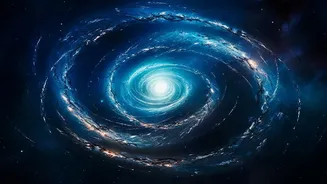
The picture that emerges is one of incredible cosmic violence. The collision with Gaia-Sausage-Enceladus was so powerful that it exerted a gravitational force that, over time, caused the entire disc of the Milky Way to perform a slow-motion somersault. It essentially tipped onto its side, fundamentally changing its orientation within its larger dark matter halo. According to Kirill Batrakov, the lead researcher, this means the vast majority of stars in our galaxy, including potentially our own Sun, once moved on completely different paths than they do today. The serene spiral we see now is the settled aftermath of this ancient upheaval.
A New Chapter in Our History
This discovery doesn't just solve a long-standing puzzle; it rewrites our understanding of how galaxies like ours are formed and evolve. It suggests that galactic history is not a gentle story of steady growth, but is punctuated by violent, transformative events. These collisions and subsequent reorientations may be a common, if not crucial, part of galaxy formation across the universe. While researchers say they cannot be 100 percent certain without more evidence, the connection between a major collision, a slow halo, and a disc flip provides the most elegant explanation for the galaxy we inhabit today. It reminds us that even something as vast as a galaxy is not static, but a dynamic structure constantly shaped by its cosmic environment.