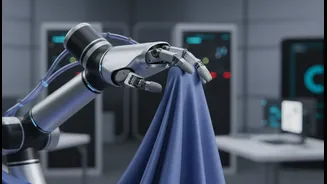










The Daily Challenge of Dressing
For many elderly individuals and people with disabilities or recovering from injury, the simple act of putting on a shirt can be a daily hurdle. Limited mobility, pain, and other physical constraints can make this essential task difficult, frustrating,
and sometimes even unsafe to perform alone. For years, the solution has been human assistance, but this isn't always available and can feel like a loss of independence. The promise of robotic assistance has long been a goal, offering a way to restore autonomy and dignity. Yet, early attempts often missed a crucial element: a gentle touch.
The Old Guard of Robotic Assistants
Initial forays into assistive dressing often involved what many people picture when they think of robots: rigid, multi-jointed arms. These machines, like those seen in manufacturing, were programmed to perform a task. Researchers at institutions like Georgia Tech developed robots that could learn to slide a hospital gown onto a person's arm by analysing thousands of simulations. However, manipulating soft, flexible clothing onto a soft, moving human body is an incredibly complex challenge. Rigid arms, even those equipped with sensitive force-feedback, present risks. They can be uncomfortable, impractical, and even dangerous if the cloth snags or the person moves unexpectedly. This fundamental disconnect between hard robots and soft humans has been a major barrier to widespread adoption.
A Softer, Gentler Approach
The latest breakthrough comes from the field of soft robotics. Instead of rigid metal and plastic, researchers are using flexible materials to create actuators that move when powered by air. This is the core of pneumatic technology. Think of it not as a robotic skeleton, but as a set of artificial muscles that can be integrated directly into clothing. These soft pneumatic actuators, often called PneuNets, are made from materials like silicone and are designed with internal chambers and channels. When air is pumped in, the chambers expand, causing the material to bend, stretch, or stiffen in a controlled way. This approach is inherently safer, lighter, and more adaptable than any rigid counterpart.
How the New Technology Works
A recent innovation from researchers at South Korea's KAIST and Stanford University showcases this new direction. They have developed a technology using soft, air-powered 'vines' embedded directly into a garment. Inspired by climbing ivy, these vines are designed to grow from their tip when pressurised with air. This action allows the garment to gently glide up and along the wearer's body, effectively dressing the person without needing them to stay perfectly still. The process is quick, taking about 10 seconds for a full suit. Because the system is part of the clothing itself, it moves with the person, adapting to their shape and movement in real-time. This eliminates the need for complex visual sensors and algorithms that try to predict a person's motion.
More Than Just a Prototype
This ivy-inspired robotic clothing is a significant step forward. The research, published in a peer-reviewed journal, highlights that a key advantage is its simplicity and stability; it doesn't require complex controls and can navigate the curves of the human body smoothly. While this specific technology is a recent development, it builds on years of research from institutions like Harvard and MIT into soft, textile-based actuators for wearable robotics. These systems have shown promise in reducing muscular effort and can be made so low-profile they are almost invisible under other clothing. The focus is shifting from creating a robot that helps you dress to creating clothing that dresses you.
The Future of Independent Living
The implications of this technology are vast. Beyond helping the elderly and people with permanent disabilities, these self-dressing garments could be used by emergency workers needing to quickly don protective gear without using their hands, or even workers in semiconductor cleanrooms. For many, however, the greatest impact will be on personal independence and quality of life. By making daily routines more manageable, this technology allows individuals to live more independently for longer. It represents a fundamental shift in assistive robotics—moving from external, machine-like helpers to integrated, human-centric solutions that empower from within. The goal is no longer just to complete a task, but to do so with comfort, safety, and dignity.