



Cosmic Detective Work
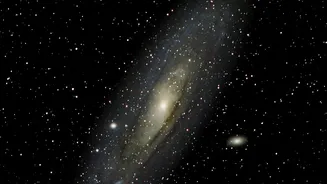
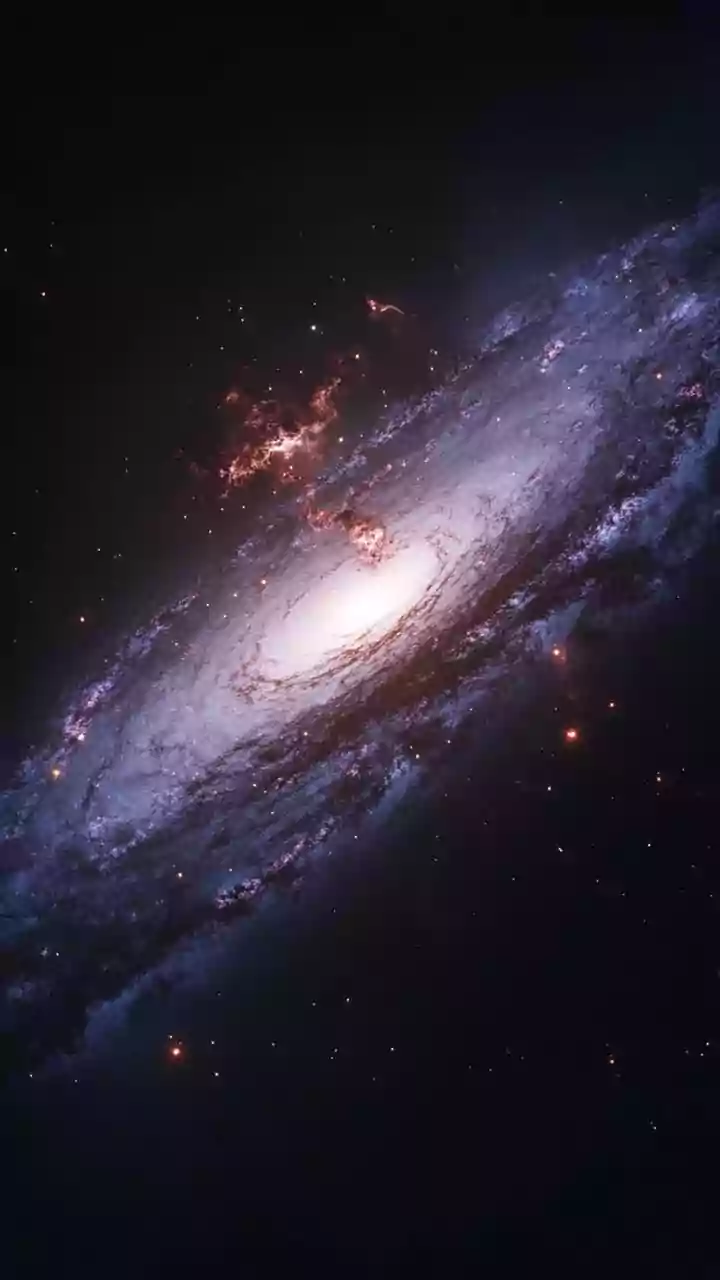
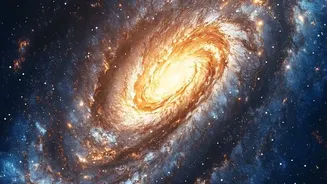
Imagine trying to map the history of an entire city by studying every single person in it. That's essentially what astronomers have done for the Andromeda galaxy. Using a treasure trove of data from NASA's Hubble Space Telescope, a team of researchers
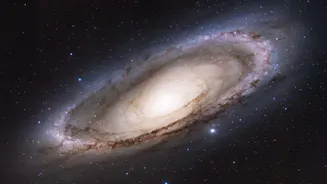
meticulously analyzed roughly two-thirds of Andromeda's sprawling disk. They measured about 200 million individual stars, treating each one like a tiny fossil holding clues to the galaxy's past. This Herculean effort involved two massive surveys, the Panchromatic Hubble Andromeda Treasury (PHAT) and its southern counterpart, PHAST, which provided an unprecedentedly sharp view of our galactic neighbor, located 2.5 million light-years away.
Reading the Rings of History
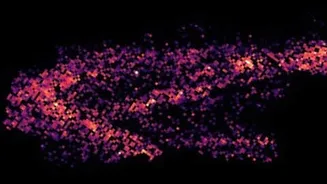
The key to unlocking Andromeda's history lies in the stars themselves. Massive, young stars burn hot and blue but have short lives, while smaller, less massive stars are redder and live for billions of years. By mapping the colors of stars across the galaxy, scientists can pinpoint areas of recent star birth (bluer regions) versus older, quieter zones (redder regions). This technique revealed that much of Andromeda's star formation is concentrated in distinct rings. One particularly prominent ring of dust and gas, located about 32,000 light-years from the galaxy's center, has been a major hub of activity. These rings are like the growth rings of a tree, with each one marking a different era of the galaxy's life.
A Tale of Boom and Bust
The study's timeline tells a dramatic story. About two billion years ago, Andromeda experienced a massive starburst—a period of incredibly intense star formation, likely triggered by a collision or interaction with another, smaller galaxy. However, the new research shows that the party is winding down. Over the last 500 million years, star formation has been steadily declining. The rate dropped significantly, and the decline has become even steeper in the last 40 million years. 500 million years ago, Andromeda was churning out stars at a rate of about one solar mass per year. Today, that has plummeted to just one-fifth of a solar mass annually. This slowdown is most pronounced in that main star-forming ring, suggesting the galaxy is entering a quieter, middle-aged phase of its life.
A Galactic Collision Culprit?
So what caused this change? Astronomers believe past and present interactions with smaller satellite galaxies are a major factor. The two-billion-year-old starburst was likely the result of a gravitational tussle. More recently, scientists are looking at M32, a compact satellite galaxy of Andromeda. The team found a 'dead zone' with very little star formation in the part of Andromeda's disk closest to M32. This suggests M32 may have plunged through Andromeda's disk around 60 million years ago, disrupting the gas clouds needed to create new stars and contributing to the recent decline. These galactic bumps and bruises leave lasting marks, shaping how a galaxy evolves over eons.
A Glimpse into Our Own Future
Studying Andromeda isn't just about understanding another galaxy; it offers a preview of our own Milky Way's destiny. Andromeda and the Milky Way are on a collision course, set to merge in about 4.5 billion years. By examining how past interactions have shaped Andromeda's star formation, we get a clearer picture of the cosmic processes that build and change galaxies over time. This detailed history, pieced together from millions of stellar 'fossils', shows that galaxies are not static but dynamic, evolving systems. It confirms that Andromeda is transitioning from an active, star-forming galaxy to a more quiescent state, a natural phase in the life of a massive galaxy like our own.