


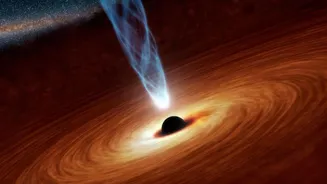
A New Class of Cosmic Giants
Astronomers are accustomed to dealing with objects of immense size. Supermassive black holes (SMBHs), found at the centers of most galaxies, can be millions or even billions of times more massive than our sun. For example, Sagittarius A*, the black hole at the heart
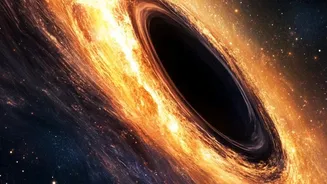
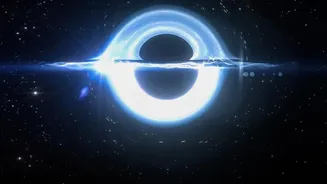
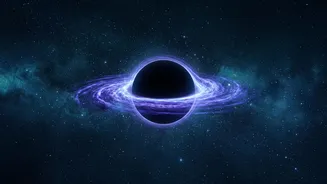
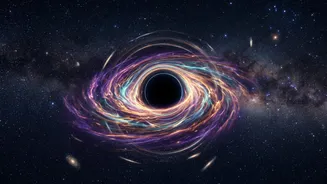
of our own Milky Way, weighs in at about four million solar masses. The largest black hole ever observed, TON 618, has a staggering mass of 66 billion suns. But now, a class of even larger, purely hypothetical objects is being considered: Stupendously Large Black Holes, or SLABs. As the name suggests, these would be true titans, with proposed masses starting at 100 billion times that of the sun and potentially reaching far greater sizes.
An Origin Story Before Galaxies
So, how could something so colossal come into being? Standard supermassive black holes are thought to grow by consuming stars, gas, and dust from their host galaxy, or by merging with other black holes. However, scientists believe there is a physical limit to how fast this can happen. For a black hole to reach 100 billion solar masses through this conventional 'feeding' process, it would likely take longer than the current age of the universe. This has led theorists to a more exotic origin story. Instead of forming from a collapsed star inside a galaxy, SLABs might be 'primordial' black holes. This theory suggests they could have formed from immense density fluctuations in the extremely early universe, moments after the Big Bang, well before the first stars or galaxies even existed. This would allow them to start with a much larger initial mass and grow from there.
The Link to Dark Matter
The potential existence of SLABs is deeply connected to one of the biggest mysteries in physics: dark matter. This enigmatic substance is thought to make up about 85% of the matter in the universe, holding galaxies together with its gravitational pull, but it has never been directly observed. For a time, scientists wondered if SLABs could be the dark matter everyone was looking for. However, recent studies suggest this is unlikely. If dark matter were composed of such massive objects, it would make the universe 'grainy' on a large scale, which is not what observations of the cosmic microwave background—the leftover radiation from the Big Bang—show. While SLABs probably aren't dark matter themselves, proving their existence would lend significant support to the theory of primordial black holes (PBHs). And if PBHs can be stupendously large, they could also exist in smaller, asteroid-sized forms, which remain a viable candidate for dark matter.
Searching for Invisible Giants
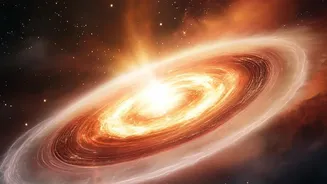
Although no SLAB has ever been confirmed, scientists have several ideas for how we might detect one. One method is through gravitational lensing. A SLAB's immense gravity would be powerful enough to warp the path of light from distant objects behind it, creating distorted or multiple images of a background galaxy or quasar. Another potential sign would be their gravitational influence on surrounding objects, which could be detected by observing the movements of stars and gas in intergalactic space. While the 'latest report' in question refers to ongoing theoretical work and analysis of cosmological data, the search is an active frontier. Researchers believe that by studying the faint glow of the early universe and looking for the tell-tale shadows or lensing effects of these giants, they could one day find definitive proof.