



A Forest Untouched by Time
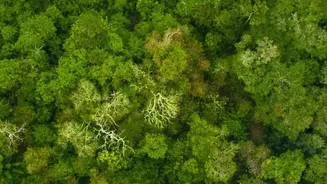
Bialowieza is one of the last and largest remaining tracts of lowland old-growth forest in Europe, a landscape that has been continuously forested since the last Ice Age. Its power lies in its complexity. Unlike managed forests, Bialowieza is a mosaic
of life and death. Up to 25% of its wood mass consists of dead trees—standing snags and fallen logs. This decaying wood is the foundation of the ecosystem, providing critical habitat for thousands of species of fungi, insects, and other invertebrates. It also acts as a nursery for seedlings and helps the soil retain moisture, which builds resilience against drought. This cycle of decay and rebirth, largely undisturbed by human hands in its core areas, is the engine of the forest's longevity.
The Kingdom of the European Bison
No story of Bialowieza is complete without the European bison, the continent's heaviest land animal. After being hunted to extinction in the wild in the early 20th century, the species was saved by a few individuals in captivity. Bialowieza Forest became the site of its historic reintroduction to nature in 1952. Today, the forest is home to the world's largest free-roaming population, with about 900 individuals on the Polish side alone. The bison's survival is a testament to the forest's ability to support large mammals. Their grazing helps shape the landscape, maintaining a balance between open meadows and dense woodland, further contributing to the area's rich biodiversity.
A Shield of Formal Protections
The forest's ancient character is defended by a multi-layered system of legal safeguards. The entire area is a UNESCO World Heritage site, a designation it has held in part since 1979 and which was expanded in 2014 to cover nearly 142,000 hectares across both Poland and Belarus. It is also recognized as an EU Natura 2000 site, protecting key habitats and species. The core of the forest is protected as national parks on both sides of the border. These parks have strictly protected zones where human intervention is minimal, limited to scientific research and guided tourism. This approach allows ecological processes to unfold naturally, preserving the forest's 'wild' character.
An Ecosystem Managing Itself
Beyond human laws, the forest has its own powerful protective systems. It is a complete, functioning ecosystem where natural population dynamics are still at play. Populations of predators like wolves and lynx help regulate the numbers of herbivores such as red deer and roe deer. Natural disturbances, like trees falling in a storm or bark beetle outbreaks, are not seen as disasters to be 'cleaned up' but as vital parts of the forest's life cycle. These events create gaps in the canopy, allowing light to reach the forest floor and spurring new growth, creating a complex, multi-generational structure that is far more resilient than a uniform, single-age forest.
Modern Threats at the Gates
Despite its protected status, Bialowieza is not immune to modern pressures. The most significant recent threat has been a border wall constructed between Poland and Belarus, which physically divides the ecosystem, blocks wildlife migration corridors for bison and lynx, and disrupts hydrology. Past controversies over increased logging in the managed parts of the forest also highlight the ongoing conflict between conservation and economic interests. Furthermore, different management strategies between the various administrative zones and a lack of a single integrated plan for the entire site remain points of concern for conservation bodies. Climate change also poses a long-term threat, potentially altering the hydrological balance and stressing certain tree species.