


A Breakthrough View of the Sun
Scientists have captured the most detailed images of the sun's surface to date, revealing a landscape teeming with previously unseen activity. Using the world's largest solar observatory, the Daniel K. Inouye Solar Telescope in Hawaii, an international
team of researchers spotted tiny, swirling whirlpools of plasma, some as small as 20 kilometres wide. These miniature vortices are the first direct observation of a phenomenon known as the Kelvin-Helmholtz instability (KHI) in the sun's photosphere, its visible surface. This type of instability happens when two fluids moving at different speeds slide past each other, creating a shear force that develops into vortices—an effect we can see in swirling clouds on Earth.
What is Fluid Turbulence?
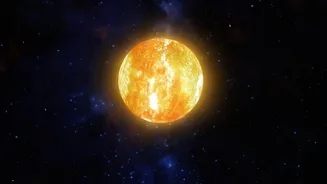
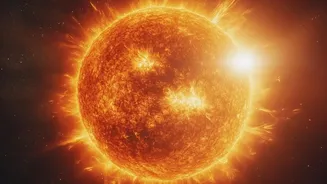
Imagine stirring cream into a cup of coffee. The complex, chaotic swirls that form are a perfect example of turbulence. The sun's surface is a much more extreme version of this. It's not a solid body but a massive ball of ionised gas called plasma, which is constantly in motion. This plasma bubbles up from the interior, cools, and sinks back down in a process called convection, creating a pattern of bright cells called granules. For decades, scientists understood that the sun's magnetic field was generated by these large-scale movements, a process called the solar dynamo. However, the role of small-scale, chaotic turbulence was a missing piece of the puzzle.
Connecting Chaos to Cosmic Order
The new discovery shows that at the edges of the sun's granules, where plasma flows meet strong magnetic field concentrations, the conditions are perfect for Kelvin-Helmholtz instabilities to form. These tiny, constant whirlpools were previously too small to be seen. The Inouye Solar Telescope's ability to resolve structures just tens of kilometres across has finally revealed that these turbulent vortices are constantly stirring the sun's magnetic field lines. Rather than just being random noise, this turbulence actively twists and braids the magnetic field, a bit like coiling a spring. This process is crucial because it provides a mechanism for how the sun builds up and stores immense amounts of magnetic energy.
Solving a Solar Mystery
This finding could help solve several long-standing mysteries about our star. One of the biggest is the 'coronal heating problem': why the sun's outer atmosphere, the corona, is hundreds of times hotter than its surface. Scientists have theorised that tiny, constant explosions called 'nanoflares' could be responsible. The continuous twisting of magnetic fields by these turbulent vortices may be the driving force that builds up the energy released in these nanoflares. Furthermore, the discovery could explain how the sun's magnetic field changes over its 11-year cycle. Current models struggle to account for how quickly the magnetic field rearranges itself. The mixing caused by these vortices may help magnetic fields spread through the solar atmosphere much faster than previously thought.
Why This Discovery Matters for Earth
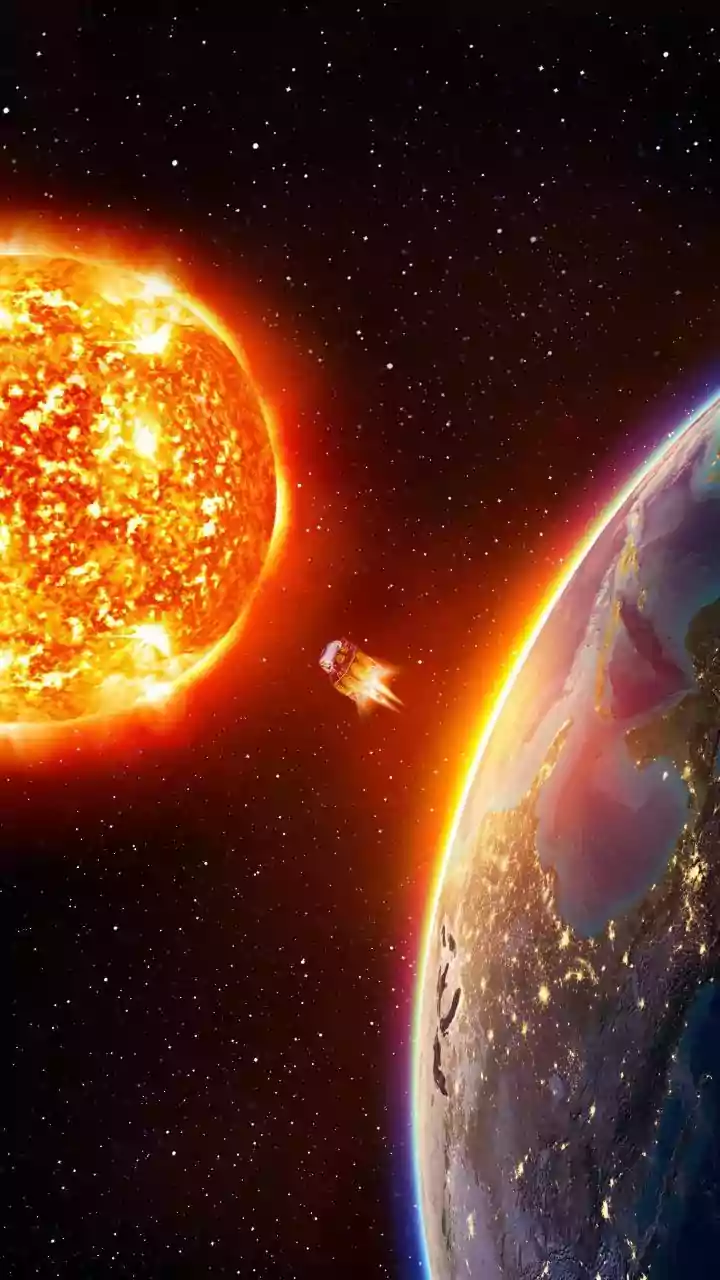
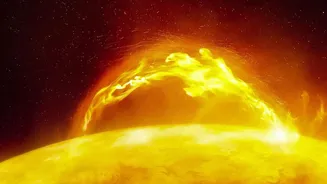
A deeper understanding of the sun's magnetic engine isn't just academic; it has practical implications for life on Earth. The same magnetic energy that is built up by turbulence can be unleashed in massive solar flares and coronal mass ejections (CMEs). When these powerful bursts of particles and radiation are aimed at Earth, they can disrupt satellites, endanger astronauts, and even damage power grids on the ground. By incorporating this new understanding of turbulence into their models, scientists hope to improve their ability to forecast this 'space weather'. Better predictions would give us more time to protect our critical technological infrastructure from the sun's powerful and sometimes violent outbursts.