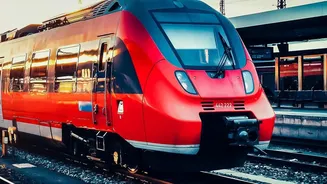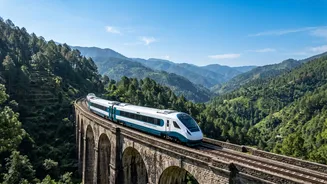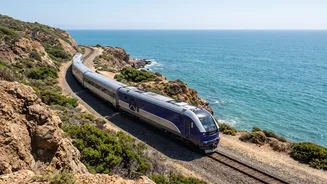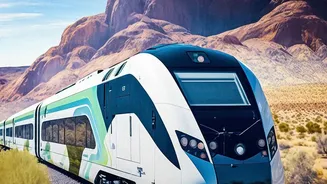




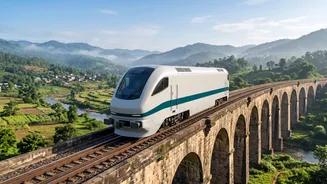
A Major Leap in Green Mobility
On September 27, 2026, Union Home Minister Amit Shah flagged off the eight-coach passenger train, marking a significant milestone in Indian Railways' quest for alternative fuel solutions. The inaugural run took place between Sabarmati and Mahesana. This
launch is a key part of a broader strategy to reduce the carbon footprint of the world's fourth-largest rail network and move towards its ambitious goal of becoming a net-zero carbon emitter by 2030. While the buzz is significant, it's important to understand what this technology actually entails. It’s not a train that runs purely on LNG, but rather a sophisticated hybrid.
How Does an LNG Train Work?
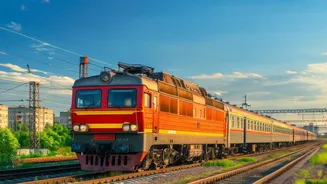
So, what exactly is under the hood? The train operates on a dual-fuel system, which means it uses both LNG and conventional diesel. Indian Railways has retrofitted two 1,400-horsepower Driving Power Cars (DPCs) with a system that allows LNG to substitute up to 40% of the diesel consumed. Think of it as a hybrid car that can intelligently switch between petrol and electricity. This flexibility is crucial, as it allows the train to operate on existing diesel engine architecture without being entirely dependent on a new fuel infrastructure that is still being developed. Before its official launch, the technology underwent over 2,000 kilometres of rigorous field trials to ensure its performance and reliability.
The Twin Benefits: Greener and Cheaper
The primary motivations behind this innovation are both environmental and economic. By replacing a substantial portion of diesel with LNG, Indian Railways expects a significant reduction in harmful emissions, including carbon dioxide, nitrogen oxides (NOx), and particulate matter. This makes the air cleaner along non-electrified routes. But the benefits don't stop there. The move is also financially prudent. Based on trial data, the railways estimate an annual fuel saving of approximately ₹11.9 lakh per power car, which translates to nearly ₹24 lakh for an eight-coach train. In a network as vast as Indian Railways, scaling up such savings could have a massive impact on operational costs.
A Bridge to a Sustainable Future
This LNG train is a crucial transitional technology. While 100% electrification remains a primary goal for Indian Railways, many routes are still reliant on diesel. The LNG dual-fuel system provides a practical, immediate solution to cut emissions and costs on these non-electrified corridors. It serves as a bridge technology, helping to decarbonise operations while the infrastructure for fully electric or even hydrogen-powered trains is expanded. Unlike a hydrogen train, which requires an entirely new propulsion system and dedicated infrastructure, the LNG conversion adapts existing technology, making it a more accessible intermediate step. Each converted power car is fitted with a 2,200-litre cryogenic tank, capable of holding enough LNG for extensive operations, reducing the need for frequent refuelling.
What's Next for Indian Railways?
The launch at Sabarmati was part of a larger package of railway projects worth over ₹1,472 crore, which also included the expansion of the indigenous 'Kavach' anti-collision system and the doubling of railway lines to increase capacity. The introduction of the LNG-powered train demonstrates a clear intent to diversify the energy mix and innovate. While it is still a fossil fuel, LNG is a cleaner-burning alternative that aligns with the nation's broader goals of reducing import dependence and achieving its climate targets. The success of this pilot project will likely determine how quickly and widely this dual-fuel technology is adopted across the rest of the country's vast rail network.