



A Star's Explosive Choice
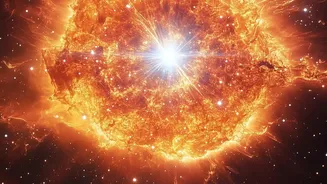
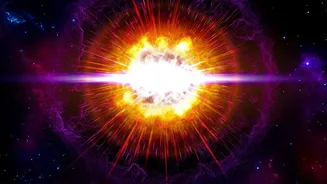
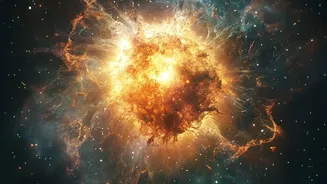
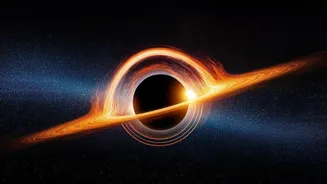
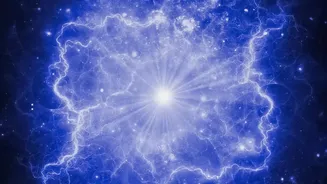
For stars much larger than our Sun, life ends in a dramatic fashion. After exhausting their nuclear fuel, the immense force of their own gravity causes their core to collapse in an instant. This process triggers one of two outcomes. In some cases, the collapse rebounds,
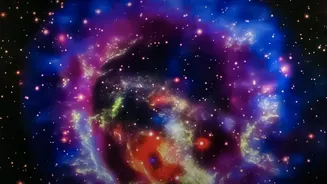
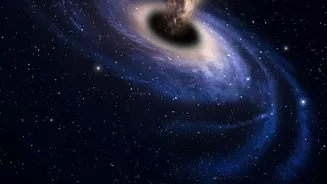
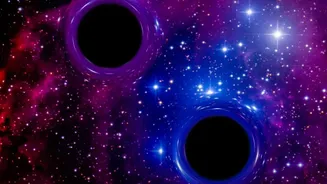
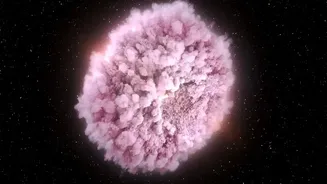
launching a cataclysmic explosion called a supernova that forges heavy elements and scatters them across the cosmos. In other cases, the explosion fails, and the star continues to collapse into a black hole, an object so dense that not even light can escape. For decades, astronomers have struggled to understand what tips the scales between these two fates. Computer simulations have had trouble reliably predicting which stars will explode and which will vanish. The number of supernovae we observe in the universe is also lower than models suggest, a puzzle known as the 'supernova rate problem'. Recent research points to a surprising culprit: the humble neutrino.
The Universe's Ghost Particles
Neutrinos are fundamental particles that are almost massless and interact so weakly with other matter that trillions of them pass through your body every second without a trace. Because they are so elusive, they are often called 'ghost particles'. However, during the core collapse of a massive star, they are produced in such staggering numbers that they carry away about 99% of the total energy released. A tiny fraction of this immense neutrino flood is reabsorbed by the material just outside the star's core. This process, known as neutrino heating, is what scientists believe provides the crucial push needed to power a supernova explosion. A small change in how these neutrinos behave can mean the difference between a successful explosion and a failed one that leads to a black hole.
A 'Goldilocks Zone' for Stellar Collapse
The new study, published in the journal Physical Review D, focuses on a fascinating aspect of neutrino physics called 'flavour conversion'. Neutrinos come in three types, or flavours, and they can switch between them as they travel. Researchers at the University of Copenhagen ran 195 simulations of dying stars, with masses ranging from 9 to 120 times that of our Sun. They discovered that including the effects of neutrino flavour conversion had a dramatic impact on the outcome. For a specific group of stars—those between 16 and 30 times the mass of the Sun—this effect was particularly strong. In the simulations, many stars in this mass range that were predicted to explode as supernovae instead failed and collapsed into black holes when flavour conversion was accounted for. This suggests that this mass range is a kind of 'Goldilocks zone' where the star's fate is exquisitely sensitive to the subtle physics of neutrinos.
Why This Breakthrough Matters
This discovery provides a potential solution to the long-standing supernova rate problem. If stars in this critical mass range are more likely to collapse into black holes than previously thought, it could explain why astronomers observe fewer supernova explosions than expected. More importantly, it fundamentally changes how scientists must approach models of stellar death. It shows that particle physics and astrophysics are deeply intertwined; you cannot fully understand the life cycle of a star without also understanding the quantum behaviour of its smallest components. By identifying a specific mass range where neutrino effects are most prominent, the study gives astronomers a clear target. Future observations of supernovae and their remnants, combined with neutrino detections on Earth, can now be used to test these models more precisely. Ultimately, understanding how massive stars die is crucial to understanding our own cosmic origins, as the supernova explosions are the cosmic forges that created many of the heavy elements, like the iron in our blood and the calcium in our bones.