





A Whisper Across the Void
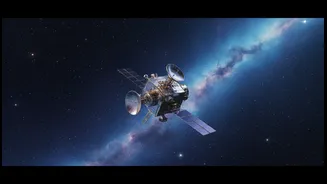
Launched in 1977, NASA's twin Voyager spacecraft are now the most distant human-made objects in existence. Voyager 1, for instance, is hurtling through interstellar space, the region between stars, at over 60,000 kilometres per hour. As of late 2026,
it will reach a staggering milestone: it will be one light-day away from us. This means a radio signal, travelling at the fastest speed possible, will take a full 24 hours to travel from Earth to the spacecraft. The round trip for a command and its confirmation will take two days. This immense distance transforms engineering into a slow, patient correspondence with the cosmos, fundamentally changing how researchers interact with their robotic probe.
The Challenge of a Fading Signal
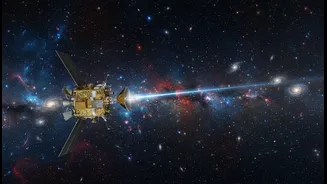
The primary enemy of deep space communication is physics itself. As a radio signal travels, it spreads out, and its strength drops dramatically with distance. The power received on Earth from Voyager is infinitesimally small—billions of times weaker than a standard watch battery. To catch this cosmic whisper, NASA relies on its Deep Space Network (DSN), a global array of massive, ultra-sensitive radio antennas in California, Spain, and Australia. These dishes, some as wide as 70 metres, are the planet's ears, straining to detect the faint call from the edge of the solar system. The data rate is incredibly slow, currently around 160 bits per second—far slower than the dial-up modems of the 1990s. Every single bit is a victory snatched from the void.
A Race Against Time and Cold
Beyond the signal, there is another ticking clock: power. The Voyagers are not solar-powered; they are too far from the Sun. Instead, they rely on radioisotope thermoelectric generators (RTGs), which convert the heat from decaying plutonium into electricity. But after nearly 50 years, these nuclear batteries are fading. Each year, their output drops by about four watts. To keep the spacecraft alive, engineers have been painstakingly shutting down non-essential systems, including heaters and some scientific instruments. In April 2026, an instrument that had been running for almost 49 years had to be powered down to conserve energy. It's a delicate balancing act to save every last watt, hoping to keep at least one instrument running into the 2030s.
Irreplaceable Data from Beyond
So, why go to all this trouble? Because the Voyagers are sending back data that no other spacecraft can. Having passed beyond the Sun's protective magnetic bubble (the heliosphere), they are directly sampling the interstellar medium for the first time. The two remaining active instruments on Voyager 1 measure the magnetic fields and plasma waves of interstellar space. This information is crucial for understanding the environment our solar system moves through, how stars form, and the very structure of our galactic neighbourhood. This isn't just about looking at distant stars through a telescope; it is about being there, touching the space between them and reporting back on what it feels like.
The Human Drive to Explore
The story of Voyager is not just one of technology, but of human curiosity. For decades, teams of dedicated scientists and engineers have guided these probes. The challenges faced mirror the ambitions of space agencies around the world, including our own ISRO. As India pushes its own frontiers with missions to the Moon, Mars, and beyond, the lessons from Voyager's longevity and the science of deep space communication are invaluable. These robotic pioneers represent a universal drive to explore, to push boundaries, and to learn our place in the universe. They are a testament to what can be achieved when we dare to aim for the stars.