








The Grand Vision: From Chips to Racks
For years, NVIDIA's business model was straightforward: design the world's most powerful graphics processing units (GPUs) and sell them to everyone from gamers to data centers. Now, the company has a much grander vision. Instead of just supplying the engines
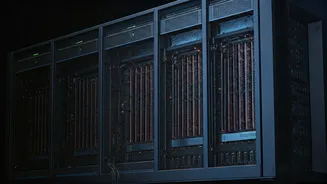
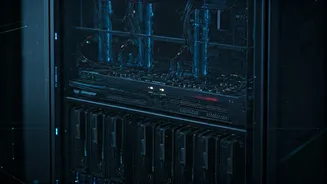
for the AI revolution, NVIDIA wants to sell the entire factory. This is the essence of its 'rack-scale' strategy. A prime example is the GB200 NVL72 system, a monolithic, 1.5-ton behemoth that combines 72 next-generation GPUs and 36 CPUs into a single, liquid-cooled cabinet. This isn't just a server; it's a pre-built, plug-and-play AI supercomputer designed to let companies like Microsoft and Meta deploy massive AI models with unprecedented speed. The strategy is brilliant, as it moves NVIDIA up the value chain from a component supplier to a full-stack systems provider, capturing far more revenue and control in the process.
A Complexity 'Wall'
The problem is that building a machine of this complexity is exponentially harder than manufacturing individual chips. Recent reports indicate that NVIDIA's future rack-scale systems are facing significant delays. The Kyber NVL144 architecture, which was set to feature the next-generation 'Rubin Ultra' chips in 2027, has reportedly been pushed back to 2028. The culprit isn't the silicon itself, but a critical and complex circuit board known as the 'midplane' that connects all the components. These systems are an intricate dance of thousands of components, from the GPUs and CPUs to the miles of high-speed copper cabling and advanced networking switches. This has created a manufacturing and integration challenge that is proving much harder to solve than simply making more chips.
The Liquid Cooling Bottleneck
A major source of the manufacturing headache is heat. The GB200 NVL72 rack can consume up to 120 kilowatts of power, an immense thermal load that traditional air cooling simply cannot handle. As a result, direct liquid cooling has become a physical necessity. This technology, which pipes a coolant mixture directly to the chips to carry away heat, is far more efficient. However, the supply chain for these specialized systems—including pumps, custom tubing, and leak-proof quick-disconnects—is still maturing. Reports of leaks and other issues during testing have caused delays, as partners work to ensure the reliability of these complex plumbing systems. The industry is quickly discovering that the future of AI depends as much on advanced plumbing as it does on advanced silicon.
Ripple Effects Across the AI Industry
A delay in NVIDIA’s rack-scale systems is not just an internal problem; it has the potential to slow the entire AI industry. Hyperscalers like Google, Microsoft, Amazon, and Meta have committed hundreds of billions of dollars to AI infrastructure, with a huge portion earmarked for these next-generation systems. Delays force them to readjust their deployment timelines, which in turn can affect the rollout of new AI services and the training of even larger models. The setback also creates a potential opening for competitors. Rivals like AMD and Google, who are developing their own powerful AI accelerators, may be able to capitalize on any perceived weakness in NVIDIA’s ability to deliver at scale. This manufacturing wall highlights a new reality: the pace of AI progress is no longer dictated solely by chip design, but by the ability of the global supply chain to assemble and cool these increasingly powerful and complex machines.