






Prepare to have your fruit bowl turned upside down. That banana you peeled for your smoothie is, botanically speaking, a berry. But the strawberry you sliced? It isn't. This isn't a joke; it’s a fascinating quirk of botanical science.
What Really Makes a Berry?
In the everyday world
of kitchens and supermarkets, we tend to call any small, fleshy, juicy fruit a 'berry'. It's a useful culinary shorthand. But for botanists, the definition is much more specific and all about how the fruit develops. To be a true berry, a fruit must meet three strict criteria: it must grow from a single flower that has only one ovary; it must have a soft outer skin (the exocarp), a fleshy middle (the mesocarp), and a soft inner part that holds the seeds (the endocarp); and finally, it must contain two or more seeds. It's this precise, structure-based definition that leads to some very surprising members of the berry family. The main job of a fruit, botanically speaking, is to protect and spread seeds, and this specific structure is just one way that nature gets it done.
The Case for the Banana
Now, let’s apply those rules to the humble banana. A banana fruit grows from a single flower which contains a single ovary. This ticks the first box. As for the structure, the yellow peel is the exocarp, the soft, edible part we love is the fleshy mesocarp and endocarp, and if you look closely at a store-bought banana, you can see tiny black specks in the centre — those are the remnants of its seeds. Wild bananas have much larger, harder seeds. Cultivated bananas are sterile and bred to be seedless for easier eating, a trait known as parthenocarpy, but the fundamental structure remains. Because it develops from one ovary, has a fleshy pulp, and contains (or is structured to contain) multiple seeds, the banana perfectly fits the scientific definition of a berry.
Meet the Berry Impostors
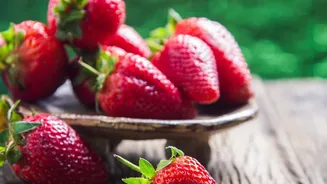
Here’s where it gets truly mind-bending: strawberries, raspberries, and blackberries are not berries at all. The reason is that they fail the 'single ovary' test. A raspberry, for example, is formed from a single flower that has multiple ovaries. Each tiny, juicy globule on a raspberry is a 'drupelet', and the whole thing is known as an 'aggregate fruit'. A strawberry is even stranger. It's called an 'aggregate accessory fruit'. The red, fleshy part we eat is actually the swollen receptacle of the flower. The true fruits are the tiny yellow specks on the outside, each of which is technically a separate fruit called an achene that contains a single seed.
The Secret Berry Club
Once you know the rules, you start seeing true berries everywhere you look. Grapes, for instance, are textbook berries. But so are many other fruits you'd never expect. Tomatoes, kiwis, and even eggplants are all botanical berries. They all develop from a single flower's ovary and contain their seeds within a fleshy pulp. And the list goes on. Avocados are technically single-seeded berries. Pumpkins, cucumbers, and watermelons are a special type of berry called a 'pepo', which is characterized by a hard, thick rind. Oranges and other citrus are a modified berry known as a 'hesperidium', which has a leathery rind and segmented flesh.
So Who Is Right, the Chef or the Botanist?
This all might seem needlessly confusing, but both classification systems — culinary and botanical — are correct and useful in their own contexts. The culinary definition of a 'berry' is based on flavour, texture, and usage. It's a practical way for us to talk about creating recipes and pairing flavours. The botanical definition, however, is based on a plant's reproductive anatomy and evolutionary history. It allows scientists to understand the relationships between different plants. So, you can relax. It’s perfectly fine to call a strawberry a berry when you're making a fruit salad. But now you have a fascinating piece of scientific trivia to share over dinner, explaining why your after-meal banana is more of a berry than the strawberries it's served with.