






What Exactly Is an AI Gigafactory?
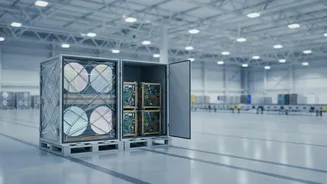
Forget the image of a traditional factory with assembly lines. An AI Gigafactory is a massive, large-scale data center specifically designed for the enormous task of developing, training, and deploying next-generation artificial intelligence models. Think
of it less as a production plant and more as a super-brain for AI. These facilities are optimized for the intense workloads required by AI, combining immense computing power from tens of thousands of specialized processors (like GPUs), high-speed connectivity, and vast data storage capabilities. Unlike a standard data center that hosts general applications, a gigafactory is a purpose-built engine designed to handle the entire lifecycle of the most advanced AI models, which can contain trillions of parameters.
The Drive for European Sovereignty
The primary motivation behind this multi-billion-euro initiative is Europe's push for technological independence, often termed 'digital sovereignty'. For years, the continent has found itself increasingly reliant on technology giants from the United States and China, which control much of the world's foundational digital infrastructure. This dependence is viewed as a significant strategic and economic vulnerability. European leaders worry that without the ability to develop advanced AI on its own infrastructure, the continent risks falling behind economically and compromising its security. The gigafactory plan is a direct response, intended to provide European startups, researchers, and industries with access to the cutting-edge tools needed to innovate, while ensuring that development adheres to the EU's own rules on data protection, safety, and ethics.
An Ambitious Public-Private Blueprint
This is not a purely government-led project. On July 30, 2026, the European Union officially launched a call for companies and investors to bid on building the gigafactories. The plan involves a two-tier structure: up to four smaller facilities and three larger ones. The initiative is backed by up to €10 billion in public funding from the EU and member states, which is expected to unlock at least another €20 billion in private investment. Consortia of companies, public entities, and investors can apply to build and operate these sites, which could be located in a single country or distributed across several member states. Major French companies, including energy provider EDF and telecom giant Orange, have already formed a consortium to bid for a site in France, signaling strong industry interest.
Significant Hurdles and High Stakes
Despite the bold vision, the path forward is filled with challenges. The project has already faced some delays, and a large portion of the public funding is contingent on the EU's next long-term budget, which is not yet approved. There's also the question of hardware. To build these powerful facilities, Europe will initially have to rely on advanced AI chips from non-European companies like Nvidia, AMD, and Qualcomm, creating a potential paradox in its quest for sovereignty. Furthermore, some analysts question whether simply building the infrastructure is enough. For the gigafactories to be successful, they must attract sufficient demand from a robust ecosystem of AI companies and researchers—a factor that will ultimately determine whether these expensive projects become true hubs of innovation or merely 'cathedrals in the desert'.