




Meet NASA's Next Great Observatory
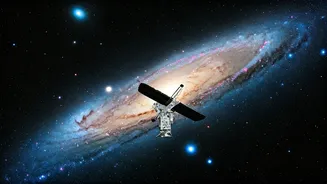
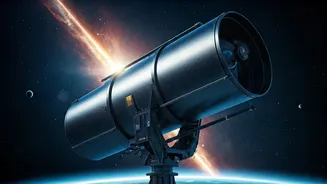
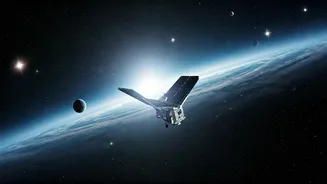
Scheduled for launch on August 30, 2026, the Nancy Grace Roman Space Telescope is set to revolutionize astronomy. Named after Nancy Grace Roman, NASA's first Chief of Astronomy and the “Mother of Hubble,” this new observatory builds on the legacy of its
predecessors but with a crucial difference: its immense field of view. While its primary mirror is the same size as the Hubble Space Telescope's at 2.4 meters, Roman’s Wide Field Instrument can capture a patch of sky 100 times larger than Hubble's infrared camera in a single snapshot. This panoramic vision means Roman can map vast swathes of the universe with incredible speed and efficiency, gathering more data in its five-year primary mission than Hubble has in over three decades.
Unraveling the Mystery of Dark Energy
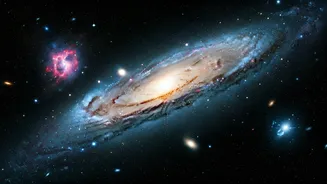
One of Roman’s primary goals is to tackle the enigma of dark energy, the mysterious force believed to be accelerating the universe's expansion. It will do this by conducting the High-Latitude Wide-Area Survey, imaging over a billion galaxies and detecting thousands of distant supernovae. Specifically, it will look for Type Ia supernovae, which are stellar explosions that shine with a consistent, predictable brightness. This quality makes them excellent “standard candles” for measuring cosmic distances. By precisely measuring their distance and how their light has been stretched by cosmic expansion, scientists can create a detailed history of the universe's expansion and learn about the nature of the dark energy driving it. This survey aims to improve our understanding of dark energy's effects by a factor of ten.
A Galactic Census of New Worlds
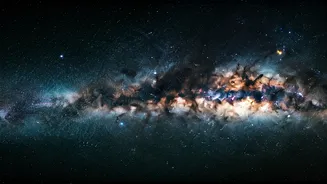
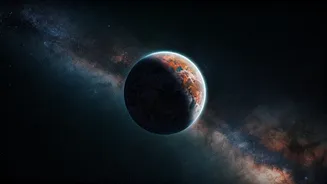
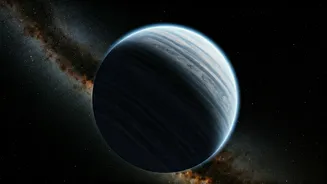
Beyond cosmology, Roman will also be a powerful exoplanet hunter. Its wide view is perfect for conducting a large-scale survey of the Milky Way, searching for planets orbiting other stars. Roman will employ a technique called gravitational microlensing, which occurs when a star and its planets pass in front of a more distant star. The gravity of the foreground star acts like a lens, magnifying the light of the background star. The presence of a planet creates a unique signature in this magnified light. This method is sensitive enough to detect planets down to the mass of Mars and will even find “rogue” planets that drift through space without a host star. Astronomers anticipate that Roman will discover thousands of new exoplanets, providing a statistical census of planetary systems in our galaxy.
A Different Tool for a Different Job
It's natural to compare Roman with the iconic Hubble and James Webb space telescopes, but it's not a replacement for either. Instead, it’s a complementary tool designed for a different kind of astronomy. Hubble and Webb are masters of the deep, narrow view, studying individual objects in incredible detail. Roman is a survey instrument, built for breadth and speed. While Webb can peer deeper into the infrared to see the universe's first galaxies, Roman will create the vast, high-resolution maps that identify the most interesting targets for Webb and other telescopes to investigate further. Its work will also include a technology demonstration of a coronagraph, an instrument designed to block starlight to directly image Jupiter-sized planets, paving the way for future missions.