




The Classic Moon Origin Story
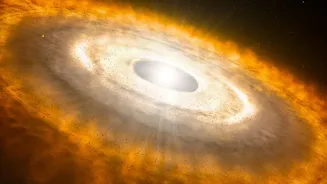
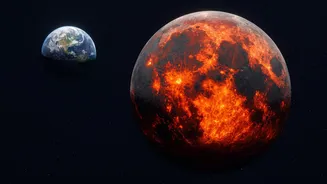
For decades, the leading scientific explanation for the Moon's existence has been the "giant-impact hypothesis". This theory proposes that about 4.5 billion years ago, when our solar system was still a cosmic construction zone, a Mars-sized planet named
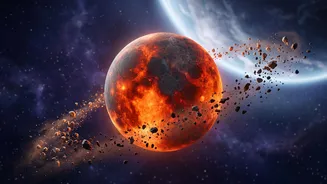
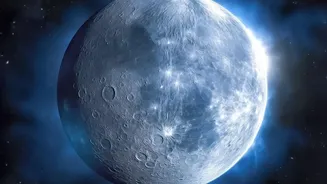
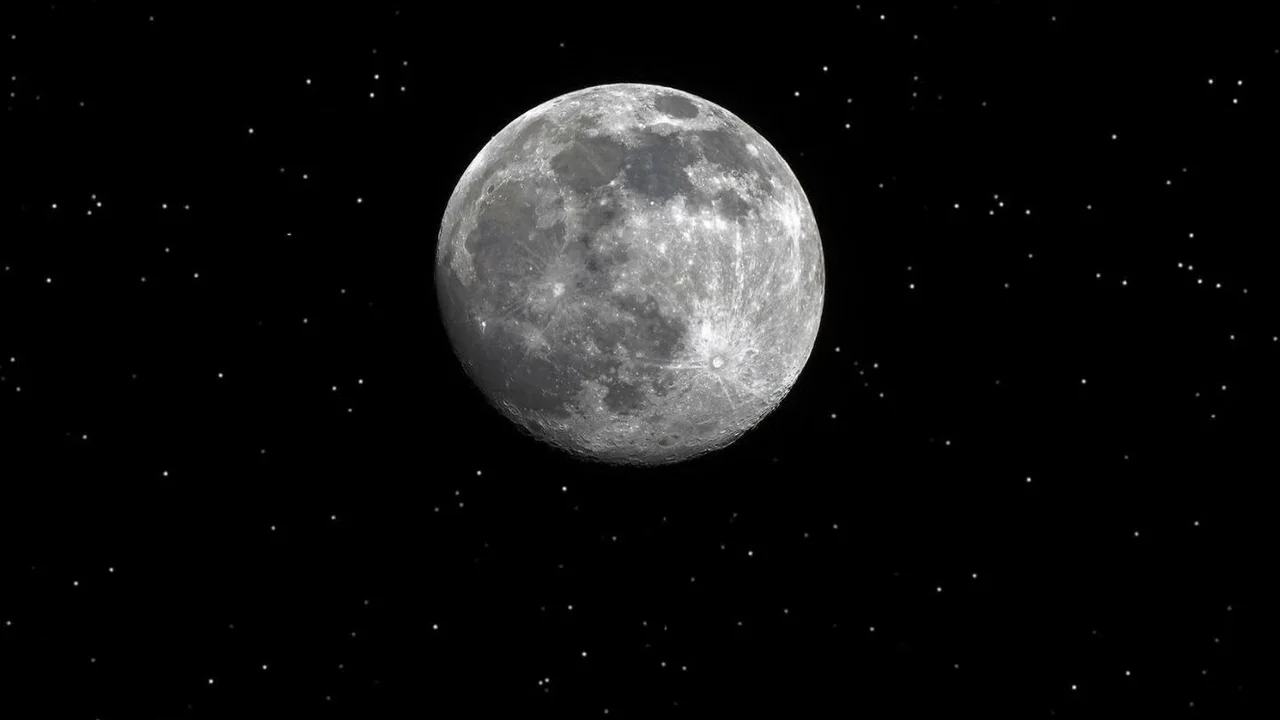
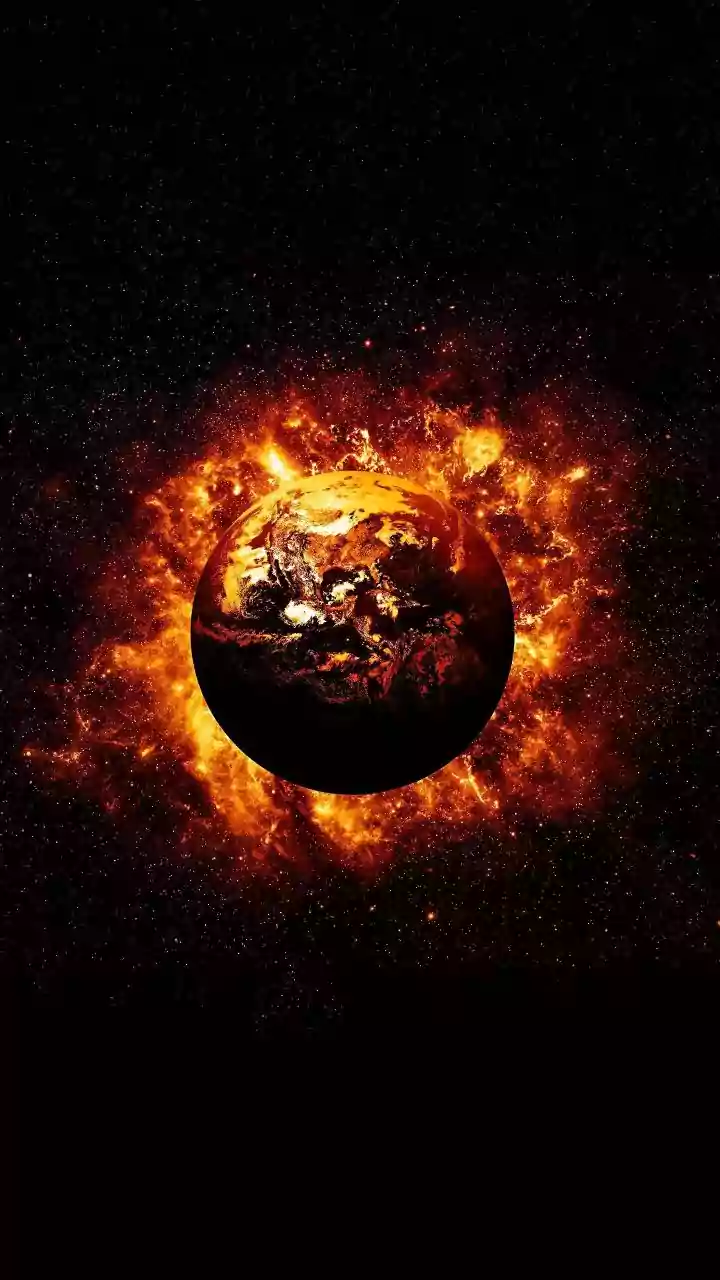
Theia slammed into a young Earth. The cataclysmic collision threw a massive cloud of molten rock and debris into orbit. According to this model, over a long period—perhaps months or even years—gravity slowly pulled this debris together, eventually forming the Moon we see today. This story elegantly explained many things, including the Moon's size and orbit. However, it left some nagging questions, particularly regarding the Moon's composition. Rock samples from the Apollo missions revealed that the Moon is strikingly similar to Earth's mantle, a fact that was hard to reconcile if it was mostly made from a foreign planet, Theia.
A New, Blink-and-You'll-Miss-It Birth
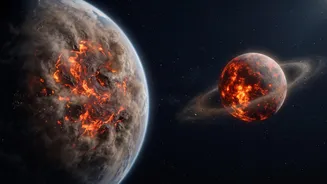
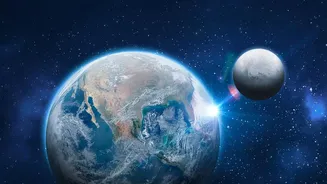
Recent studies, using some of the most powerful supercomputer simulations ever applied to the problem, are now painting a very different and much faster picture. Instead of a slow, gradual accumulation of debris, these new models show that under the right conditions, the Moon could have formed almost instantly—in a matter of hours. In this scenario, the impact from Theia was so immense that it didn't just create a debris ring; it launched a massive, partially molten chunk of Earth's own material directly into a stable orbit. This single-stage formation theory provides a cleaner explanation for why the Moon's chemical fingerprint is so similar to Earth's. By using more material from Earth's outer layers, it neatly sidesteps the problem of having to explain a chemically identical impactor.
The Power of High-Resolution Models
The breakthrough comes from a significant leap in computational power. Previous simulations were run at a lower resolution, which meant they couldn't capture the complex physics of such a massive collision in full detail. Researchers found that these standard-resolution models could be giving misleading answers. The new high-resolution simulations, which can track vast numbers of material particles, revealed new behaviours that were previously invisible. Scientists at NASA and other institutions like the Southwest Research Institute discovered that factors they previously considered less important, such as the material strength and temperature of the proto-Earth and Theia, dramatically change the outcome of the impact. It's like upgrading from a fuzzy, low-resolution video to a crystal-clear 4K picture; suddenly, you can see what's really happening.
The Key Qualification to Keep In Mind
This is where the important caveat, or "key qualification," comes in. While the idea of an instant Moon is compelling, it's crucial to remember that these are still simulations. They show what is physically possible, not necessarily what definitively happened. The outcome of the impact is highly sensitive to the initial conditions—things like the impact angle, the speed of the collision, and, as newly discovered, the temperature and internal strength of both planetary bodies. Different scenarios in the simulations can produce different outcomes, from a debris disk that forms a moon slowly to an intact moon that forms in hours. The new research doesn't prove the Moon formed in five hours; it proves that this is a plausible scenario that elegantly solves some long-standing chemical puzzles. It opens up a new range of possibilities for the Moon's evolution, but it is not yet a closed case.