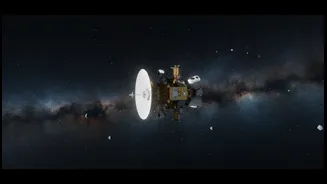





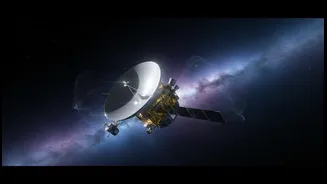


A Legacy of Firsts
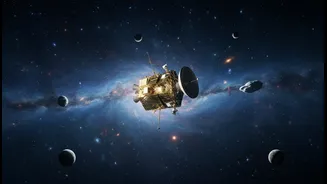
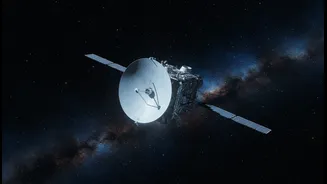
It’s easy to think of New Horizons as a mission whose greatest triumphs are behind it. Launched in 2006, it became the fastest spacecraft ever to leave Earth, received a critical gravity assist from Jupiter, and then undertook a journey of more than nine
years to its primary target. The stunning images of Pluto and its largest moon, Charon, that it sent back in July 2015 are now iconic, revealing a surprisingly dynamic world with nitrogen-ice glaciers and towering mountains of water ice. In 2019, the mission made history again with a flyby of Arrokoth, the most distant and primitive object ever explored by a spacecraft, offering a glimpse into the building blocks of our solar system. After these spectacular encounters, one might assume the mission's most exciting days were over. But for New Horizons, the journey itself has become the destination.
Waking Up in the Darkness
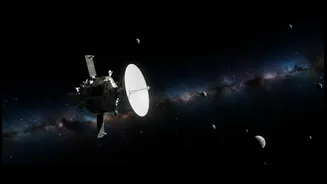
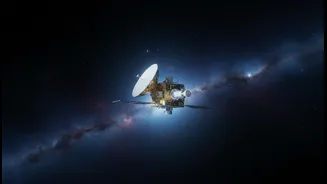
In early July 2026, after a 321-day hibernation to conserve resources, NASA confirmed that New Horizons had awakened in good health. Now approximately 9.5 billion kilometres from Earth, the spacecraft is so far away that its signals, travelling at the speed of light, take nearly nine hours to reach mission control. This isn't a sign of a mission winding down; it's the beginning of a new chapter. NASA has extended the mission, shifting its focus from planetary encounters to a unique role as a deep-space observatory. Its new purpose is to leverage its unparalleled position in the Kuiper Belt — a donut-shaped ring of icy bodies beyond Neptune — to conduct science impossible from anywhere else.
A Unique View of Our Sun
The mission's primary new focus is heliophysics — the study of our Sun and the vast bubble of influence it creates, known as the heliosphere. As the solar wind, a stream of charged particles, flows outward from the Sun, it interacts with the gas and dust of the interstellar medium. New Horizons is the only active mission with the tools to measure this environment from the outside in. While in hibernation, its instruments continued to gather data on the solar wind and dust particles. Now active again, it will use its ultraviolet spectrograph to study the distribution of hydrogen gas at the solar system's edge. By measuring how the solar wind slows down as it gets farther from the Sun, scientists can better map the boundary where our solar system ends and interstellar space begins, following in the footsteps of the legendary Voyager probes.
Eyes on the Kuiper Belt
While heliophysics is the new priority, New Horizons hasn’t stopped being a planetary science mission. From its perch in the Kuiper Belt, it continues to observe distant Kuiper Belt Objects (KBOs), studying them in ways that ground-based telescopes cannot. Its unique location allows for powerful parallax measurements, using the vast distance between it and Earth as a baseline to better determine the positions of distant objects. The spacecraft’s long-range camera has already provided evidence that the Kuiper Belt may be much larger than previously thought. Although no new flyby target has been identified, the mission team is actively searching for a reachable KBO, preserving fuel in case an opportunity arises to visit one more distant world up close before the spacecraft's power finally wanes decades from now.