

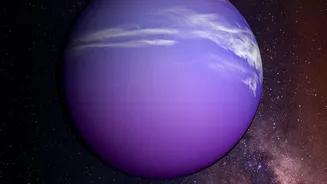

A New Planet in a Famous System
Astronomers have discovered a new giant exoplanet, named Beta Pictoris d, within a well-studied and relatively young planetary system just 63 light-years from Earth. The Beta Pictoris system has long been a fascination for scientists, as it provides a natural
laboratory for how planetary systems form and evolve. It was already known to host two other massive planets, Beta Pictoris b and c. Unlike its siblings, which were found using direct imaging, Beta Pictoris d was revealed not as a point of light but through the unique chemical signature of its atmosphere, a groundbreaking technique for planet hunting. This discovery makes Beta Pictoris only the second system known to have at least three directly imaged planets, adding another complex character to this cosmic family drama.
Decoding an Alien Atmosphere
The breakthrough came when Webb's powerful instruments detected a chemical 'barcode'—a distinctive pattern of light absorption—that could only be explained by the atmosphere of a massive planet. The primary molecule detected was carbon monoxide, but follow-up observations quickly confirmed the presence of water vapor and methane as well. This rich chemical inventory provides a much deeper understanding of the planet's composition. Finding these specific molecules allows scientists to do more than just confirm a planet's existence; it helps them model its climate, temperature, and even infer details about its formation history. The ability to detect a mix of gases marks a huge leap from simply knowing a planet is there to beginning to understand what that world is actually like.
How Webb Sniffs Out Distant Skies
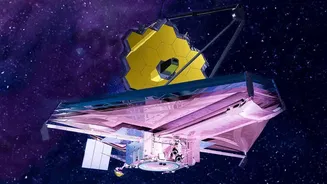
The James Webb Space Telescope uses a method called spectroscopy to perform this long-distance chemical analysis. When a planet passes in front of its host star, a tiny fraction of the starlight filters through the planet's atmosphere. Different gases in that atmosphere absorb very specific wavelengths, or colors, of light. Webb's instruments, like the Near-Infrared Spectrograph (NIRSpec), are incredibly sensitive to these subtle changes. They capture the starlight, spread it out into a rainbow-like spectrum, and measure which slivers of light are missing. These missing pieces act as a chemical fingerprint, telling astronomers exactly which molecules, like water or methane, are present in the atmosphere hundreds of light-years away. This technique is so precise it can reveal details that were once impossible to obtain.
A New Era for Planet Hunting
The discovery of Beta Pictoris d is significant not just for what it tells us about that system, but for the method used to find it. The planet was hidden within a bright disk of cosmic dust and debris that made traditional imaging difficult. By focusing on the unique chemical signals of a planetary atmosphere, astronomers were able to cut through the noise and find a world that would have otherwise remained concealed. This spectroscopic approach could transform the search for other elusive planets, especially those in dusty, complex environments. It proves that Webb can do more than just take stunning pictures; it can act as a cosmic detective, using chemical clues to uncover hidden worlds and build a more complete census of the planets in our galaxy.