


A Tale of Two Planetary Fates
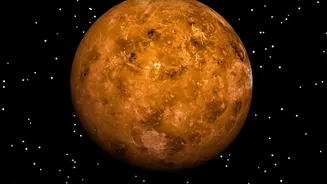
Look up at the night sky, and you’ll see our constant companion, the Moon. It stabilizes Earth’s tilt, drives our tides, and has shaped our planet's evolution. Venus, however, is solitary. Despite being similar to Earth in size, mass, and composition,
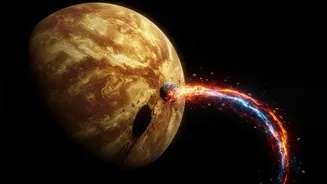
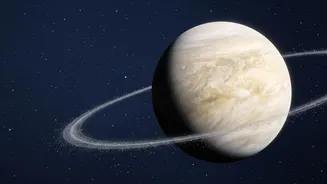
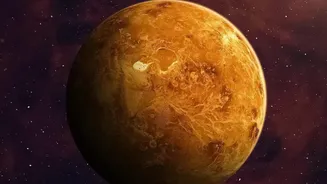
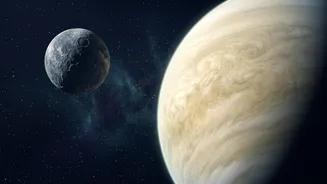
it wanders the solar system alone. For decades, scientists have puzzled over this difference. Did Venus never form a moon? Or did it have one that was destroyed by a stray asteroid? A compelling new theory suggests a third, more intimate possibility: Venus was its own moon’s undoing, a victim of its own peculiar physics.
The Slow Spin and the Death Spiral
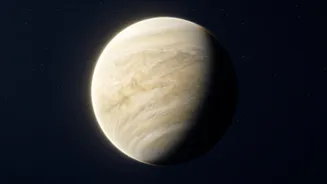
The secret, according to recent research from astrophysicists at the University of California, Riverside, lies in Venus's rotation. Earth spins relatively quickly, completing a rotation every 24 hours. This rotational energy is transferred to our Moon, pushing it away from us at a rate of about four centimetres per year. Venus is the complete opposite. It has an exceptionally slow rotation, taking 243 Earth days to complete just one spin. Computer simulations run by lead author Stephen Kane showed that this sluggishness has a profound gravitational consequence. Instead of pushing a moon away, Venus’s slow spin would cause a hypothetical moon to lose energy and spiral inward.
Simulating a Lost World
To test this idea, researchers built computer models that simulated the gravitational dance between a planet and a moon. After successfully modeling the known evolution of the Earth-Moon system to ensure accuracy, they turned their attention to Venus. They ran numerous simulations, testing hypothetical moons of various sizes and masses, from half to ten times the mass of Earth's Moon. The results were shockingly consistent: in almost every scenario, the moon was doomed. Rather than finding a stable orbit, the simulated moons were pulled inexorably toward Venus, destined to collide with the planet. The more massive the moon, the faster its demise.
The Consequences of a Cosmic Crash
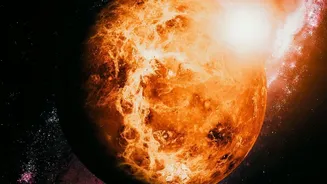
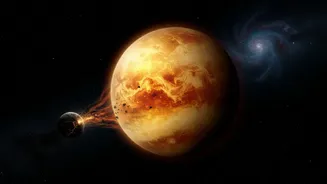
This theory doesn't just explain a missing moon; it could also help solve other long-standing mysteries about Venus. A collision with a large moon would have been a cataclysmic event, transferring enormous energy and momentum to the planet. Such an impact could have dramatically altered Venus's climate, geology, and even its rotation. Some scientists believe Venus may have once had oceans and conditions more favourable to life. A moon crash could have been the trigger that sent it down the path to becoming the scorching, high-pressure world it is today, possibly setting off the runaway greenhouse effect that defines modern Venus.
Searching for the Ghost of a Moon
While the simulations are compelling, they don't prove Venus definitely had a moon—only that it would have been very difficult to keep one. Finding direct evidence of such a collision is incredibly challenging. Venus underwent a massive volcanic resurfacing event about a billion years ago, which effectively erased most of its ancient surface history, burying any potential craters or scars. However, clues might lie deep underground. Seismic studies on Earth have found strange structures in the mantle that could be remnants of the giant impact that formed our own Moon. Future missions to Venus, like NASA’s DAVINCI+, could potentially detect similar geological anomalies or chemical traces in the atmosphere left over from a consumed moon.