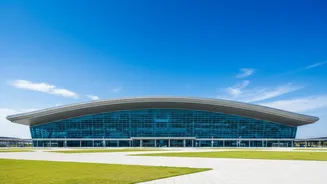







A New Leader in Global Aviation
In a historic shift, South Korea's Incheon International Airport has officially become the number one airport in the world for international passenger traffic. According to preliminary data from Airports Council International (ACI), Incheon handled 38.39
million international passengers in the first half of 2026, marking a 6.3% increase from the previous year. This achievement is a first for the airport since its opening in 2001 and places it ahead of perennial leaders like London Heathrow, which processed 37.79 million passengers, and Singapore Changi, with 34.53 million. For years, hubs in Dubai and London have dominated the top spot, making Incheon's rapid ascent a significant development in global travel patterns.
The Strategy Behind the Surge
Incheon's rise to the top wasn't accidental; it is the result of decades of strategic planning, massive infrastructure investment, and a keen ability to adapt to global shifts. A major factor was the completion of its fourth-phase expansion in late 2024, which boosted its annual capacity to 106 million passengers. This expansion made it the world's third-largest airport by international passenger capacity, perfectly positioning it to absorb growing travel demand. Furthermore, geopolitical tensions in the Middle East caused disruptions at major transit hubs, redirecting significant passenger flows toward East Asia. Incheon capitalized on this, with transfer passengers increasing by 18.1%, and those on European routes soaring by an incredible 63.2%.
More Than Just a Transit Hub
While connecting flights played a crucial role, Incheon's success is also fuelled by South Korea's own booming tourism industry. In the second quarter of 2026, foreign nationals accounted for a record 44.4% of all passengers, a significant jump from previous years. This surge is largely driven by an influx of visitors from nearby China and Japan, highlighting Incheon's role not just as a crossroads, but as a primary gateway to Korean culture. The airport itself is a destination, consistently winning awards for customer service and offering amenities like a spa, sleeping rooms, cultural museums, and even an ice rink, which enhance the passenger experience and encourage longer stays.
A Look at the Competition
Incheon's journey to the top has seen it steadily climb the ranks, moving from 10th place shortly after its opening to third by 2024 before finally securing the number one position. This year, it surpassed London Heathrow, which still had a record-breaking first half with nearly 38 million international passengers. Notably, Dubai International Airport, which has long been a leader in this category, fell out of the top five in the latest rankings. While Atlanta's Hartsfield-Jackson remains the world's busiest airport for overall traffic (including domestic flights), Incheon's dominance in the crucial international segment establishes it as a new centre of gravity for global travel.