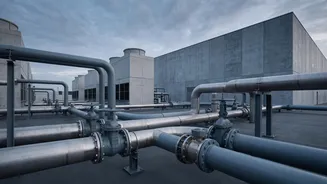







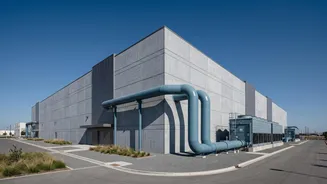

The Heat Problem of AI
At the heart of every AI application, from chatbots to complex research models, are thousands of high-performance processors packed into massive buildings called data centres. These servers generate an immense amount of heat as they perform trillions
of calculations per second. To prevent overheating and potential failure, this heat must be constantly removed. While traditional data centres for cloud storage also require cooling, the computational intensity of AI training and inference is on another level. An AI-focused hyperscale data centre can use as much electricity as 100,000 homes or more, far surpassing conventional facilities. This staggering energy consumption directly translates into an equally staggering cooling challenge.
From Gigawatts to Gallons
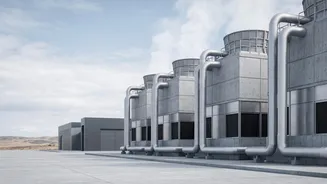
The most common and energy-efficient method for cooling these server farms is water-based evaporative cooling. In these systems, water is drawn from local sources—often municipal supplies, rivers, or aquifers—and used to cool the air or, in some cases, piped directly to the processors. As the water absorbs heat, it evaporates and is released into the atmosphere as vapour. This process is highly effective but also incredibly consumptive. A large data centre can use up to 5 million gallons of water every single day, an amount equivalent to the daily water usage of a city of 50,000 people. This means the water is permanently removed from the local watershed, unlike water used in homes that is typically treated and returned.
The Staggering Scale of Consumption
The numbers are startling. In 2022, Microsoft's global water consumption increased by 34%, while Google's rose by 20%, driven primarily by their data centres. Google reported using over 5 billion gallons of water across its data centres in 2023 alone. Even a simple interaction with AI has a water footprint; one study estimated that a chat session with around 20 queries can consume up to a bottle of freshwater. While this might seem small, the cumulative effect of millions of users is immense. Projections suggest that by 2027, global water withdrawals for AI could reach between 4.2 and 6.6 billion cubic metres, roughly half of the entire United Kingdom's annual water consumption.
A Local Dilemma in a Thirsty World
This escalating demand creates a significant dilemma, particularly for water-stressed regions. While tech companies bring jobs and investment, they also become major competitors for a finite resource. Many companies are building data centres in areas already facing water scarcity. In some communities in the United States, local governments and residents are beginning to push back, concerned about the long-term impact on their water supplies and the natural environment. The constant extraction of millions of gallons per day can disrupt local water balances, putting pressure on resources needed for agriculture, drinking water, and ecosystems. The lack of transparency from many companies about the specific water usage of individual facilities further complicates efforts to manage this growing issue.
The Search for Cooler, Drier Solutions
The tech industry is aware of the problem and is exploring innovative solutions. Some of the most promising technologies include closed-loop cooling systems, which can significantly reduce freshwater use by recycling water. More advanced methods like direct liquid cooling (DLC) and immersion cooling, where servers are submerged in a non-conductive fluid, are far more efficient at heat transfer than air or traditional water systems. These technologies can drastically cut both water and energy consumption. Companies like Microsoft have stated that their newest AI data centre designs use no water for cooling under normal operating conditions. However, these advanced systems can be costly to implement and are not yet widespread.