





Exploring how NASA's next-generation interstellar probes build upon the legacy of Voyager to unravel the mysteries of space beyond our solar system.
A New Generation of Explorer
While the headline may sound like a single new mission, it represents a broader ambition, best exemplified
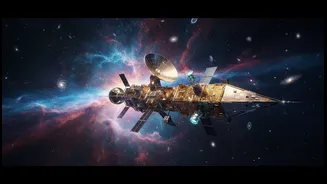
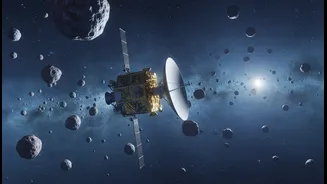
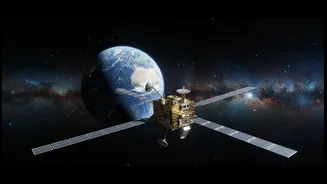
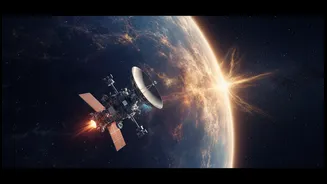
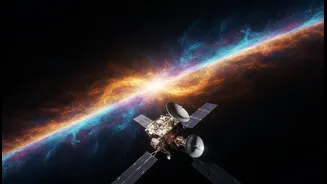
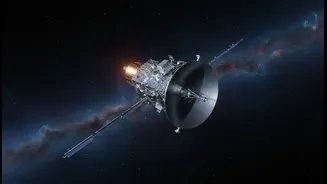
by a proposed mission concept known as the Interstellar Probe (ISP). This isn't just another spacecraft; it's envisioned as a successor to the legendary Voyager probes, designed to be what some have called "Voyager on steroids". Its goal is to travel faster and farther than any craft before it, carrying a modern suite of instruments to study the enigmatic space between the stars. The plan involves a powerful launch, possibly using the Space Launch System, to sling the probe past Jupiter for a massive gravity assist. This would propel it out of our solar system at incredible speeds, allowing it to reach the heliopause—the edge of the Sun's influence—in as little as 16 years, a journey that took the Voyagers nearly four decades.
The Heliosphere: Our Solar System's Protective Bubble
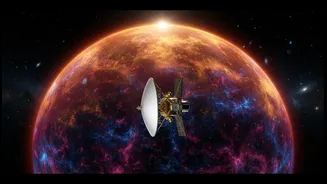
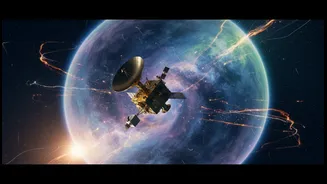
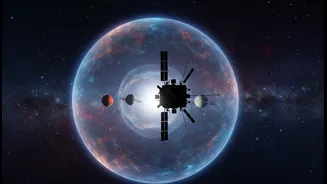
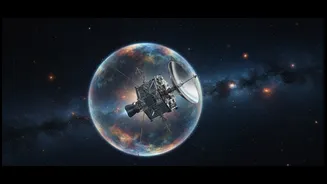
To understand the mission, one must first understand our place in the cosmos. Our solar system is enveloped in a vast bubble known as the heliosphere. This bubble is created by the solar wind, a constant stream of charged particles flowing outwards from the Sun. This outflow pushes against the interstellar medium—the gas, dust, and cosmic rays that fill the space between star systems. This boundary, called the heliopause, is where the Sun's influence stops and true interstellar space begins. The heliosphere acts as a crucial shield, protecting the planets, including Earth, from the harshest of galactic cosmic radiation. Without it, life on our planet might have evolved very differently, if at all.
Peering Beyond the Boundary
Only two human-made objects, Voyager 1 and Voyager 2, have ever crossed the heliopause and entered interstellar space. Launched in 1977 with 1970s technology, their instruments have provided invaluable but limited data about this unexplored region. Their findings revealed puzzles, such as unexpected magnetic field behaviors and particle densities. A future Interstellar Probe would be designed specifically to answer these questions. Its primary goals would be to determine the nature of the interstellar medium, explore how the heliosphere interacts with it, and study the fundamental physics of this turbulent boundary region. It would give us our first high-fidelity look at the environment our solar system is traveling through as it orbits the Milky Way.
The Legacy of Voyager
The Voyager probes were not designed for interstellar travel; their initial mission was to study the giant planets. Their extended journey into the space between stars is a testament to their robust engineering. As of mid-2026, both spacecraft continue to send back data, though their power is fading. Engineers are carefully managing their remaining energy, even shutting down instruments to keep them alive into the 2030s. In November 2026, Voyager 1 will reach a poignant milestone: it will be one light-day from Earth, meaning a radio signal will take a full 24 hours to reach it. This incredible distance highlights the challenges of deep space exploration and underscores the need for faster, more capable probes like the proposed ISP to build upon the Voyagers' pioneering work.
Technology for a 50-Year Journey
Sending a probe on a multi-decade mission into deep space requires extraordinary technology. The Interstellar Probe concept calls for a mission designed to last for over 50 years. This longevity would be made possible by next-generation radioisotope thermoelectric generators (RTGs), a type of nuclear power source that provides electricity from the heat of decaying plutonium—the same technology that has powered the Voyagers for nearly half a century. The probe would carry a suite of advanced, lightweight scientific instruments, far more sensitive and capable than those on the Voyagers, designed to measure the magnetic fields, cosmic rays, and neutral particles of interstellar space with unprecedented detail. The entire mission is a long-term investment in fundamental knowledge, pushing the boundaries of what is possible in robotics, power, and communications.