





Our Sun’s Protective Bubble
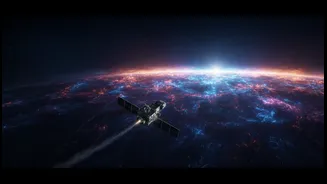
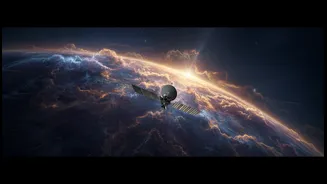
Imagine the Sun constantly blowing a gigantic bubble of charged particles out in all directions. This stream of particles, called the solar wind, travels at supersonic speeds, pushing back against the gas and dust that drifts between the stars. This bubble is the heliosphere,
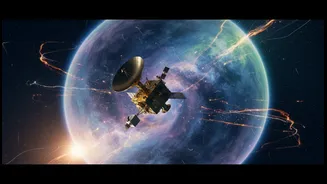
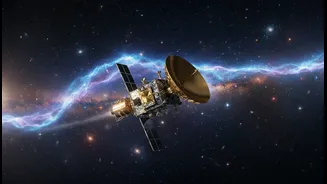
and it envelops our entire solar system, acting as a crucial shield against harsh galactic cosmic radiation. But this bubble doesn't extend forever. Far beyond the orbit of Neptune and Pluto, the solar wind finally meets the resistance of the interstellar medium and slows down dramatically. This abrupt braking zone is a shockwave known as the termination shock. It’s not a solid wall, but a turbulent, chaotic frontier where the Sun's influence begins to wane. It marks the first major step in crossing from our solar system into true interstellar space.
A Journey to the Edge
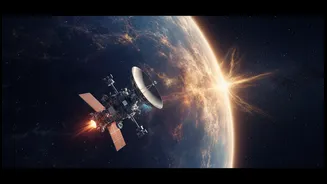
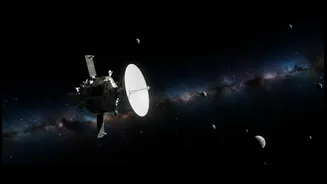
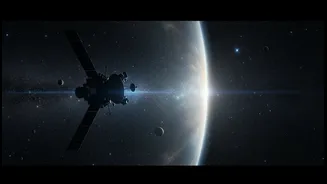
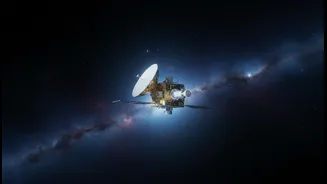
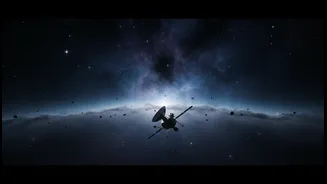
After dazzling the world with its images of Pluto in 2015 and the distant object Arrokoth in 2019, New Horizons is now on an extended mission through the Kuiper Belt, a vast ring of icy bodies. Currently more than 60 times farther from the Sun than Earth is, the spacecraft is venturing into territory explored by only two other probes in history: Voyager 1 and Voyager 2. Its trajectory is taking it directly toward the termination shock. Scientists are eagerly anticipating this crossing, but pinning down an exact date is tricky. The heliosphere isn't static; it breathes, expanding and contracting in time with the Sun's 11-year cycle of activity. Based on recent models, researchers predict New Horizons could reach the boundary anytime between the late 2020s and 2040. The boundary is so dynamic that the probe might even pass through it more than once as the heliosphere shifts.
Following in Voyager's Footsteps
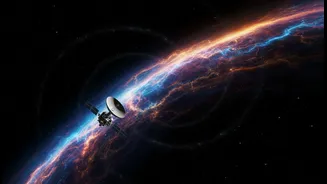
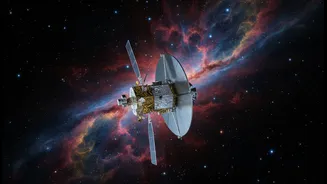
The Voyager probes rewrote the book on the outer solar system when they crossed the termination shock in 2004 and 2007. One of their most stunning discoveries was that the heliosphere isn't a perfect sphere. Voyager 1 crossed at a distance of 94 astronomical units (AU) from the sun, while Voyager 2, traveling in a different direction, crossed much closer at 84 AU. This revealed that our solar system's protective bubble is squashed and asymmetrical, likely dented by the pressure of the local interstellar magnetic field. This discovery turned theoretical models on their head and showed just how much we have to learn. The Voyagers were pioneers, gathering the first-ever direct evidence from this region. Now, New Horizons has a chance to provide a crucial third data point from a different location and time.
A Scientific Treasure Hunt
While the Voyager probes were groundbreaking, they were built with 1970s technology. New Horizons carries a more modern suite of scientific instruments, including sophisticated plasma spectrometers designed to measure the properties of the solar wind with great precision. When it reaches the termination shock, it will be able to measure the speed, temperature, and density of the particles there in greater detail than ever before. These measurements will help scientists understand the physics of how the solar wind interacts with interstellar matter. It will provide fresh insights into the shape and structure of our heliosphere and how it protects us from galactic radiation. Each new piece of data from this distant frontier helps us piece together the puzzle of our solar system's place in the wider galaxy.