


Embarking on a journey of cosmic archaeology, NASA’s Lucy spacecraft is on a grand tour of the solar system’s most mysterious objects. It's a mission to the past, exploring ancient asteroids that could unlock the secrets of how our planets formed.
An Ambitious 12-Year Voyage
Launched
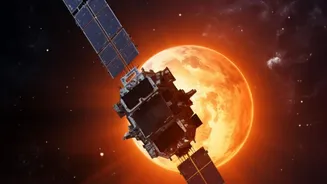
in October 2021, the Lucy mission is one of NASA's most ambitious explorations to date. The spacecraft is undertaking a 12-year, multi-billion-mile journey to visit a record-breaking number of asteroids. The mission is named after 'Lucy', the fossilized skeleton of an early hominin that provided unique insights into human evolution. Similarly, the Lucy spacecraft will study the 'fossils' of planet formation, providing a window into the solar system's birth over four billion years ago. After its launch, the mission had a dramatic start, with one of its large, circular solar arrays failing to fully latch. However, engineers on Earth masterfully stabilized the array, allowing the mission to proceed on its complex trajectory, which includes several gravity-assist flybys of Earth to build up speed.
Meet the Trojan Asteroids
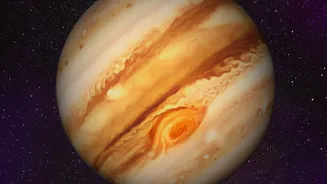
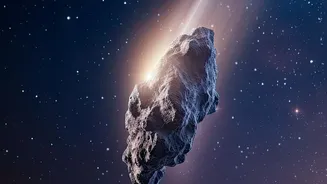
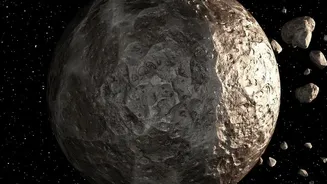
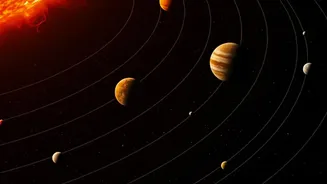
Lucy’s primary targets are the Trojan asteroids, two large groups of space rocks that share Jupiter's orbit around the Sun. One swarm, known as the 'Greek camp', travels 60 degrees ahead of Jupiter, while the other, the 'Trojan camp', trails 60 degrees behind. These unique locations are called Lagrange points, areas where the gravitational pull of the Sun and Jupiter creates stable pockets, trapping asteroids for billions of years. First discovered in 1906, thousands of these bodies are now known to exist. They are thought to be remnants of the same primordial material that formed the outer planets like Jupiter, Saturn, Uranus, and Neptune. Visiting them is like opening a time capsule, offering scientists a direct look at the building blocks of our planetary neighbourhood.
A Surprising Start to the Tour
Although the main event is visiting the Trojans, Lucy's journey has already been full of discovery. On its way through the main asteroid belt between Mars and Jupiter, the spacecraft had a planned flyby of an asteroid named Donaldjohanson in April 2025. Before that, in November 2023, the mission team added a bonus target: a small asteroid named Dinkinesh. The flyby yielded a major surprise when images revealed Dinkinesh was not alone. It had its own satellite, which scientists named Selam. Even more fascinating, Selam turned out to be a 'contact binary', meaning it's composed of two smaller objects that are touching—the first time such a body has been seen orbiting another asteroid.
The Upcoming Trojan Encounters
Having successfully passed its initial tests, Lucy is now heading towards the main part of its mission. The spacecraft is set to reach the first swarm of Trojans in August 2027. Its first target will be Eurybates and its small moon, Queta. This will be followed by encounters with Polymele in September 2027, Leucus in April 2028, and Orus in November 2028. Each of these asteroids represents a different type, showcasing the surprising diversity within the Trojan population. After visiting this first swarm, Lucy will loop back towards Earth for a final gravity assist in 2030. This maneuver will slingshot the spacecraft towards Jupiter's trailing swarm of Trojans, where it will visit the binary pair Patroclus and Menoetius in March 2033, concluding its historic tour.
What Scientists Hope to Learn
Equipped with a suite of advanced instruments, including high-resolution cameras and spectrometers, Lucy will gather a wealth of data. The primary goals are to map the geology, surface composition, and physical properties of these ancient worlds. Scientists are especially interested in the diversity of the Trojans; their surfaces range in color and composition, suggesting they may have formed in different parts of the early solar system before being captured in their current orbits. By studying their craters, minerals, and searching for the presence of organic materials, the Lucy mission aims to piece together the story of how the giant planets grew and migrated, an evolutionary process that shaped the entire solar system, including Earth.