


A Cosmic Lineup
On August 10, 2026, NASA’s Astronomy Picture of the Day (APOD) featured a stunning new image that captures not one, but three distinct pairs of galaxies. At first glance, the frame is a beautiful collection of six galactic swirls set against the blackness
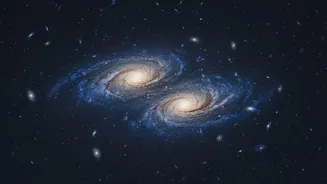
of space. But for astronomers, it’s a perfect illustration of a fundamental challenge: determining which celestial objects are true companions and which are just ships passing in the night. The image, credited to astrophotographer Rafael Sampaio, gathers galaxies from the Centaurus Galaxy Cluster and forces us to ask: are these pairs gravitationally bound together, or are they separated by immense voids, their proximity just a matter of perspective from Earth?
Pair One: The Cosmic Deception
The topmost pair in the image provides a classic example of an optical illusion. It features two galaxies that appear close, but are likely not interacting at all. One of these, NGC 4650A, is a rare and fascinating object known as a polar ring galaxy. This structure, with a ring of gas and stars orbiting at a right angle to the main galactic disk, is thought to be the aftermath of a past galactic collision. So, while NGC 4650A itself tells a story of interaction, its current apparent partner is probably just a background object. Think of it like holding your thumb up to the Moon; they look close, but one is vastly farther away.
Pair Two: A Close Call
The middle pair presents a more ambiguous scene. These two galaxies, including the large spiral galaxy NGC 4650, look like they ought to be interacting. Their shapes seem to align, and they appear to be at a similar distance. However, astronomers have determined that their relative speeds are too different for them to be gravitationally bound. They are likely flying past each other at high velocity, too fast to be captured by each other's gravity. It's a cosmic near-miss, a reminder that proximity in a single snapshot doesn’t tell the whole story of a dynamic, multi-billion-year-old universe.
Pair Three: The True Collision
Finally, the bottom pair, NGC 4622A and NGC 4622B, showcases what a genuine galactic interaction looks like. These two are actively engaged in a gravitational dance that will eventually lead to their merger. In perhaps a billion years, they will cease to be two distinct entities and will combine to form a single, larger galaxy. The tell-tale signs of their interaction are already visible to astronomers, who can detect the tidal forces warping their structures. This kind of merger is a key driver of galaxy evolution, fueling bursts of star formation and ultimately creating new, more massive galaxies.
Why Perspective Is Everything
Distinguishing between true interacting pairs and chance alignments is crucial for modern astronomy. Understanding which galaxies are merging helps scientists refine their models of galaxy evolution, from the formation of giant elliptical galaxies to the triggering of supermassive black holes at their centers. It’s the difference between studying a real relationship and drawing conclusions from a photobomb. By carefully measuring redshift to determine distance and velocity, astronomers can peel back the layers of our two-dimensional view of the sky to reveal the true, three-dimensional structure of the cosmos. This single image, with its three distinct stories, is a powerful reminder that in space, you can’t always judge a galaxy by its neighbor.