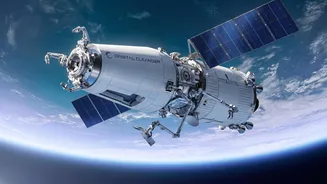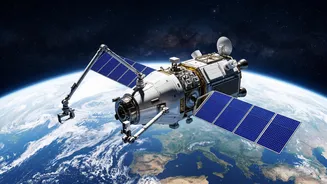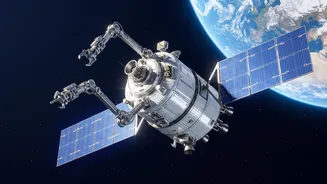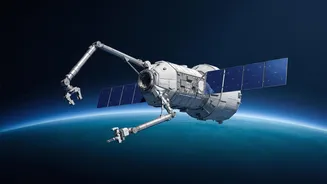





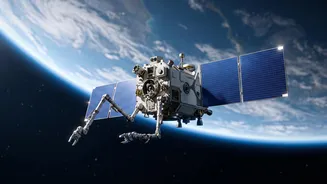
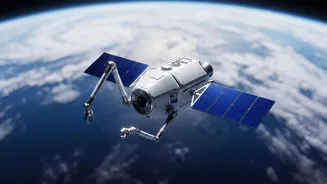
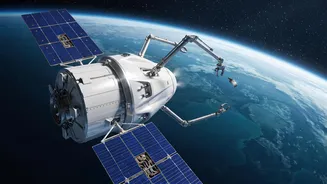
Ever wanted to name a spaceship? Now’s your chance. The UK Space Agency is launching a world-first mission to clean up Earth’s orbit and is asking the public to give its satellite-grabbing spacecraft a memorable name.
A Cosmic Cleanup Mission
Dubbed the Active Debris Removal (ADR)
mission, this pioneering UK-led project is designed to tackle the growing problem of space junk. The plan involves launching a specially designed spacecraft, built by ClearSpace UK, that will hunt down, capture, and dispose of two defunct satellites currently orbiting Earth. Using advanced robotics, including giant claws, the craft will grab onto two non-operational, UK-licensed satellites and guide them into a lower orbit. From there, they will be released to safely burn up in the Earth’s atmosphere, leaving the cosmic neighbourhood a little tidier. This will be the first time a single spacecraft has been tasked with removing more than one piece of debris, showcasing technology that could be vital for future space sustainability.
The Junkyard Above Our Heads
For decades, humanity has been launching rockets and satellites, creating an orbital junkyard that poses a significant threat. There are hundreds of thousands of tracked objects whipping around our planet at speeds exceeding 17,000 miles per hour. These range from dead satellites and spent rocket stages to tiny flecks of paint. While space agencies track objects larger than 10 cm, it's estimated there are millions of smaller, untraceable pieces that are still big enough to cause catastrophic damage to active satellites that provide us with services like GPS, weather forecasting, and communications. Events like the accidental collision of two satellites in 2009 and intentional anti-satellite tests have dramatically increased the amount of debris, making missions like the UK's ADR not just innovative, but essential.
Your Chance to Make History
The UK Space Agency, in partnership with the Association of Science and Discovery Centres, has opened the naming competition to all UK residents. The rules are simple: suggest a memorable name of no more than two words and provide a short explanation of up to 150 words on how it reflects the mission's theme of keeping space clean and safe. The competition runs from October 15, 2026, until 5:00 pm on December 10, 2026. The winning entry will not only become the official mission name but will also be featured on the spacecraft's mission patch. Submissions can be made online via the UK Space Agency's website, and while individuals of all ages can enter, those under 18 must have a parent, guardian, or teacher submit on their behalf.
Learning from 'Boaty McBoatface'
Of course, inviting the British public to name something important comes with a certain level of delightful risk. The internet never forgets the 2016 competition to name a polar research vessel, which famously resulted in the public overwhelmingly choosing 'Boaty McBoatface'. While officials ultimately named the ship after Sir David Attenborough, the public's choice lived on as the name for one of its submersibles. Unsurprisingly, suggestions for the debris-removal craft are already pouring in with similar creativity. Names like 'Debris McGee', 'Obi-Wan Cleanobi', and nods to British cleaning icons like the Wombles and Henry the vacuum cleaner have flooded social media. The agency has set guidelines, asking for names that are politically neutral and easy to pronounce, hoping for an inspirational title like NASA's 'Mercury' or Tim Peake's 'Principia' mission.