




A Whirlwind Discovery on the Sun's Surface
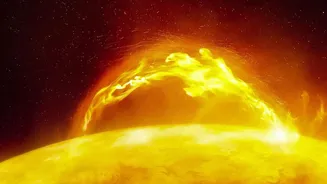
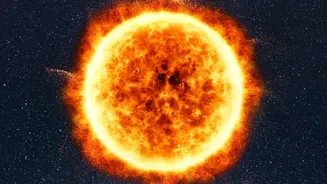
Imagine looking at the Sun and seeing not just a blazing ball of light, but a surface covered in a pattern of boiling, Texas-sized cells of hot gas. Now, imagine looking closer at the edges of these cells and finding something new: tiny, frantic whirlpools
of plasma, some measuring less than 20 kilometres across. This is the groundbreaking discovery made by scientists using the world's most powerful solar telescope. For the first time, they have directly observed these miniature vortices, which had been predicted by theory for over a century but were too small to be seen until now. These are not just any swirls; they are signatures of a phenomenon called the Kelvin-Helmholtz instability, which occurs when two fluids, or in this case plasmas, flow past each other at different speeds. Think of wind blowing over water to create waves—it's a similar principle, but happening on the intensely magnetic and violent surface of our star.
The Eye on the Star
This unprecedented view of the sun was captured by the National Science Foundation's Daniel K. Inouye Solar Telescope (DKIST) in Hawaii. Perched on the island of Maui, this four-metre telescope is a marvel of modern engineering designed to give us the sharpest view of the sun ever possible. To put its power into perspective, resolving a 20-kilometre feature on the sun is comparable to spotting a one-euro coin from 180 kilometres away. The images were so detailed they revealed a solar landscape unlike anything seen before, full of dynamic, swirling patterns at the edges of magnetic areas. By combining these ultra-high-resolution images with sophisticated computer simulations, researchers from institutions across the US and Germany confirmed that what they were seeing matched the theoretical predictions for these tiny, energetic events.
Why These Tiny Tornadoes Matter
While a 20-kilometre vortex may sound small for a star that is 1.4 million kilometres in diameter, its implications are enormous. One of the biggest puzzles in astrophysics is the coronal heating problem: the sun's outer atmosphere, the corona, is hundreds of times hotter than its visible surface, the photosphere. This defies the basic laws of thermodynamics, which suggest it should be cooler the further you get from the heat source. Scientists have long suspected that some mechanism must be transporting vast amounts of energy from the surface up into the atmosphere. These newly discovered vortices could be a key part of that mechanism. They are believed to twist and braid the sun's magnetic field lines, storing energy like a coiled spring. This stored energy can then be explosively released, potentially feeding the mysterious heat of the corona and powering small solar eruptions known as nanoflares.
Connecting a Star to Our World
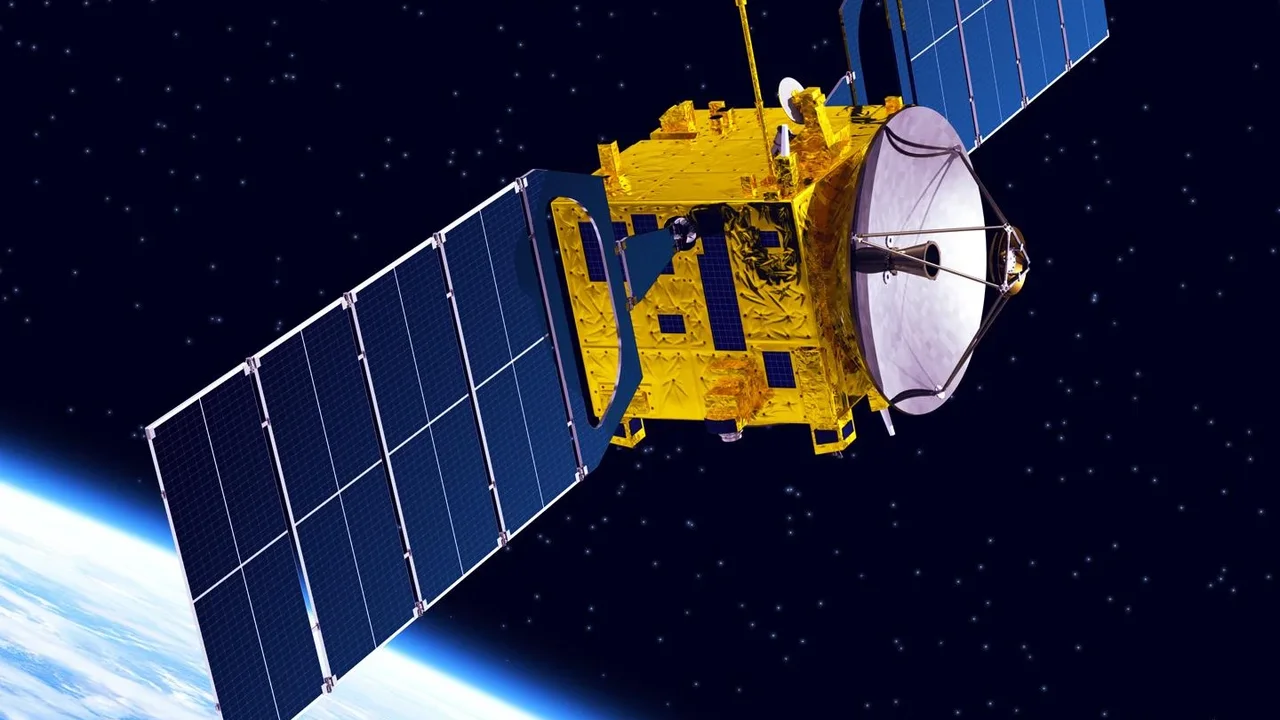
Understanding these fundamental solar processes isn't just an academic exercise. The sun's activity directly impacts us on Earth. Solar flares and coronal mass ejections, which are large-scale releases of plasma and magnetic fields, drive space weather. Severe space weather can disrupt our power grids, damage satellites, and interfere with GPS and communication systems. The discovery of these small vortices provides a crucial new piece of the puzzle. By revealing how magnetic energy builds up and moves through the sun's lower atmosphere, this finding could dramatically improve our models of solar activity. Better models lead to better predictions, giving us more time to prepare for and mitigate the effects of potentially damaging space weather events. In essence, by seeing the smallest structures on the sun, we get a giant leap forward in safeguarding our technologically dependent world.