




A Ghost From Deep Space
Imagine a particle so ethereal it can pass through entire planets without leaving a trace. That’s a neutrino. Often called 'ghost particles', they have almost no mass, no electric charge, and interact so rarely with other matter that trillions of them
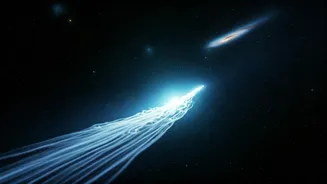
are passing through you at this very moment, completely unnoticed. While most neutrinos that reach Earth are lower-energy particles from our own Sun, some are ultra-high-energy travellers from the most violent events in the cosmos. These rare messengers are what scientists at the IceCube Neutrino Observatory are hunting for. Because they travel in a straight line from their origin, undeflected by magnetic fields, they are perfect pointers to their cosmic sources.
The World’s Strangest Telescope
The IceCube observatory isn't a telescope in the traditional sense. Instead of using mirrors to capture light, it uses a cubic kilometre of pristine Antarctic ice, located deep beneath the South Pole. Over 5,000 light sensors, called Digital Optical Modules, are embedded in the ice on long strings. When a high-energy neutrino happens to collide with an atom in the ice, it creates secondary particles that emit a faint flash of blue light, known as Cherenkov radiation. The sensors detect this light, allowing scientists to reconstruct the neutrino's energy and, most importantly, the direction it came from, turning the Antarctic continent itself into a massive particle detector.
The 'Shadow Blaster' Emerges
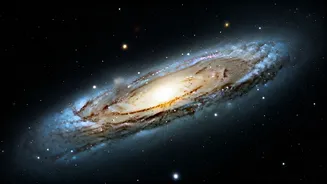
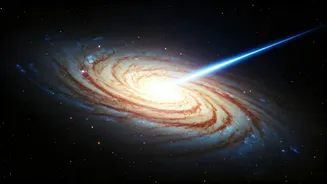
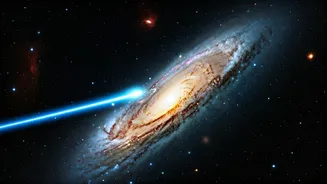
In 2021, IceCube detected a particularly high-energy neutrino, catalogued as IC 210922A. Immediately, observatories around the world turned their attention to the patch of sky it came from, looking for a cataclysmic event like an exploding star or a flaring black hole that could have launched it. But they found nothing — the sky was unusually quiet. This led researchers to look in longer wavelengths of light, capable of peering through thick cosmic dust. There, they found the culprit: a distant, intensely star-forming galaxy previously hidden from view. Nicknamed the 'Shadow Blaster' by astronomers, this galaxy is a powerhouse of star creation, shrouded in so much dust that its light is obscured.
A New Kind of Cosmic Cannon
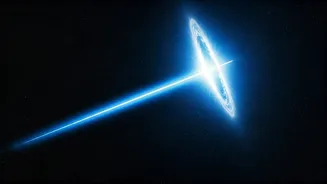
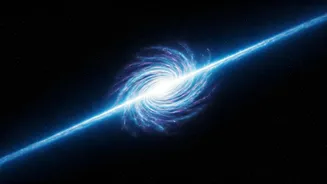
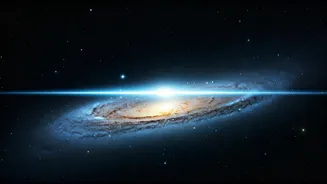
This discovery is significant because it points to a different kind of neutrino source. Previously, the few confirmed sources of high-energy neutrinos were blazars. A blazar is an active galaxy where a supermassive black hole at its centre shoots a jet of particles and radiation directly at Earth at nearly the speed of light. These are the most energetic objects known in the universe. The 'Shadow Blaster' galaxy, however, is not a blazar. It's a 'starburst' galaxy, a cosmic nursery creating new stars at a furious rate. This suggests that the collective chaos of star formation and supernova explosions in such dusty environments could also be powerful enough to accelerate particles and create high-energy neutrinos.
Opening a New Window on the Universe
This finding marks a major step forward in the field of multi-messenger astronomy, which combines information from different cosmic 'messengers' like light, gravitational waves, and neutrinos to get a complete picture of an event. For years, astronomers have detected a diffuse background of high-energy neutrinos coming from all directions, but the known sources, like blazars, couldn't account for all of them. The discovery of the 'Shadow Blaster' suggests that dusty, star-forming galaxies could be responsible for a significant portion of this unexplained neutrino flux. It opens a new window for understanding the most extreme environments in the cosmos, long hidden behind veils of dust.