

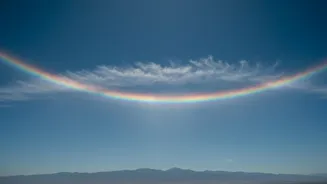


Not Fire, Not a Rainbow
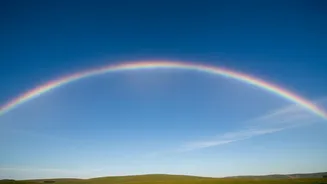
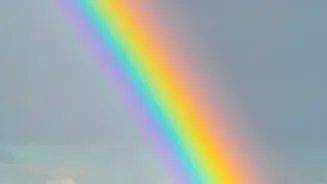
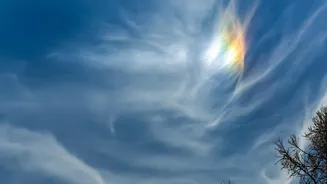
First things first, the term 'fire rainbow' is a captivating misnomer. The phenomenon has nothing to do with fire, though its appearance in wispy, fragmented clouds can resemble colourful flames in the sky. It's also not a rainbow, which is formed by
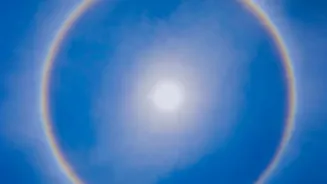
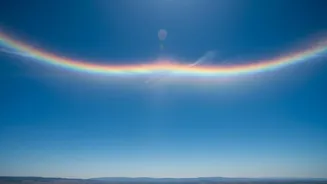
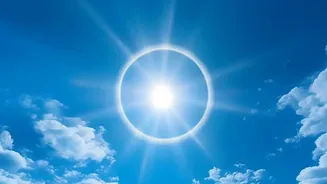
the refraction and reflection of light in water droplets from rain. Instead, the scientific name for this event is a circumhorizontal arc. It belongs to a family of optical phenomena called ice halos, which are created when light interacts with ice crystals suspended high in the atmosphere. Unlike a normal rainbow that arcs across the sky after a storm, a circumhorizontal arc is a vast, colourful band that runs parallel to the horizon.
The Scientific Recipe
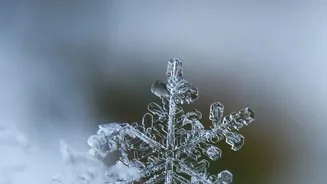
For a fire rainbow to grace the sky, a very specific set of ingredients must come together perfectly. The first is the presence of high-altitude cirrus clouds, which are thin, wispy clouds found above 20,000 feet where temperatures are low enough for them to be composed of millions of tiny ice crystals. Crucially, these ice crystals must be shaped like flat, hexagonal plates and be oriented horizontally, almost like tiny floating prisms. The final, and most critical, ingredient is the position of the sun. For the light to refract correctly through the ice crystals and split into its spectrum of colours, the sun must be very high in the sky—at an elevation of at least 58 degrees above the horizon. This precise alignment requirement is why circumhorizontal arcs are relatively rare.
NASA's Textbook Example
NASA's Astronomy Picture of the Day (APOD) for August 2, 2026, featured a spectacular fire rainbow, drawing renewed attention to the conditions that create it. While the featured image itself was captured in 2021 over West Virginia, USA, its selection highlights a perfect illustration of the phenomenon. NASA’s explanation accompanying the image reinforces the science: ice crystals in a distant cirrus cloud acting as prisms. The key takeaway, emphasised by this feature, is the non-negotiable role of the sun's angle. If the sun is lower than 58 degrees, sunlight entering the ice crystals will be internally reflected instead of passing through the bottom face to create the colourful arc. The arc's intensity is actually at its peak when the sun is even higher, at about 68 degrees.
Your Fire Rainbow Checklist
So, how can you spot one yourself? The headline’s “checklist” is a great way to think about it. First, check the time and location. These arcs are most common during the summer months at mid-latitudes when the sun can reach the required height. In places north of 55°N or south of 55°S, the sun never gets high enough, making the phenomenon impossible to see. India's latitude makes it a possible, though still rare, location. Second, look for the right clouds. You need thin, wispy cirrus clouds high in the sky. Heavy, low-level clouds will block the view. Finally, pay attention to the sun's position. The best time to look is during the middle of the day when the sun is at or near its highest point. If all three conditions align—high sun, high cirrus clouds, and the right time of year—you might be lucky enough to witness this breathtaking display.