



Hubble's Unprecedented View
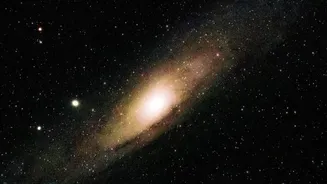
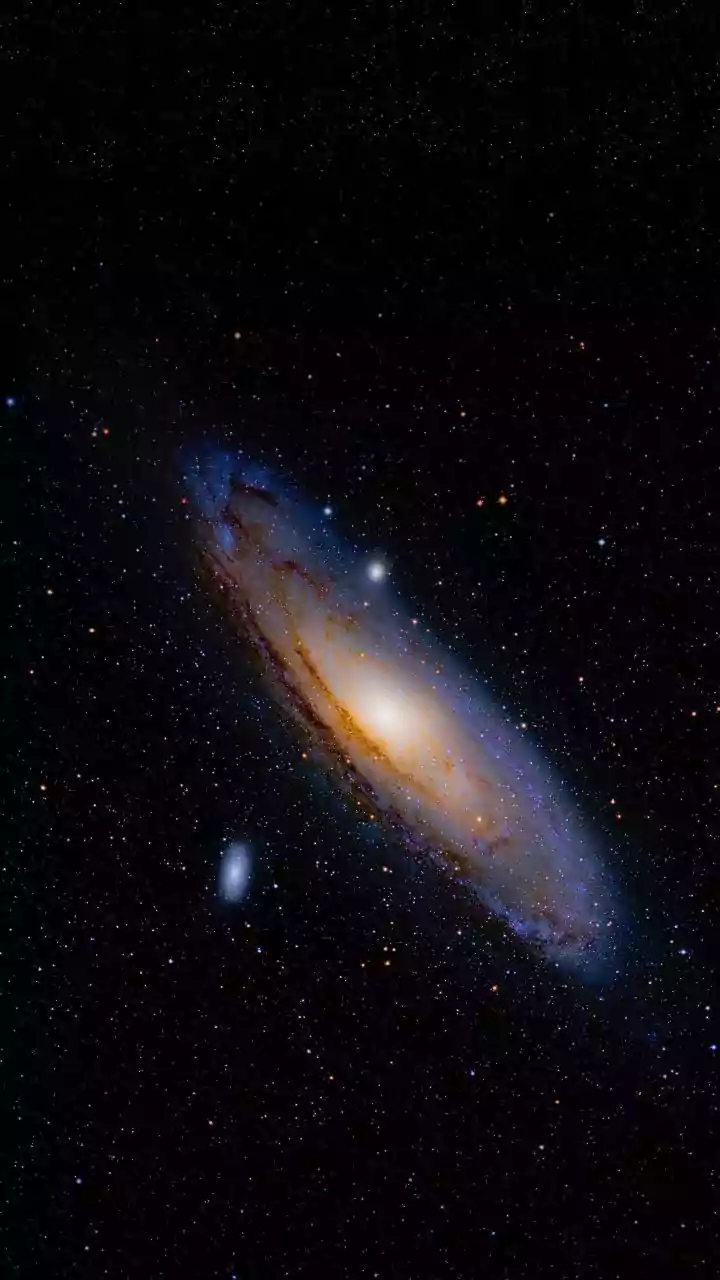
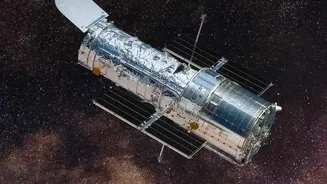
To understand the life story of a galaxy, you need to read its fossil record: its stars. The Hubble Space Telescope is uniquely capable of this task for Andromeda. Located 2.5 million light-years away, our neighbor is close enough for Hubble to resolve
hundreds of millions of individual stars, yet far enough to capture a panoramic view of its structure. A massive project, combining the Panchromatic Hubble Andromeda Treasury (PHAT) and its southern counterpart (PHAST), created a detailed map of nearly two-thirds of the galaxy's star-forming disk. By analyzing the color and brightness of some 200 million stars, astronomers can distinguish between hot, blue, short-lived stars and cooler, redder, long-lived ones, effectively creating a timeline of when and where stars were born.
A Galaxy Winding Down
The study confirms what astronomers suspected: after a massive baby boom of stars about 2 billion years ago, likely caused by a galactic merger, Andromeda's productivity has been on a steady decline. The new research reveals this slowdown has been particularly pronounced over the last 500 million years. Back then, Andromeda was creating stars at a rate of about one solar mass per year, similar to the Milky Way's current output. But by 40 million years ago, that rate had halved. Today, it has plummeted to just one-fifth of a solar mass per year, a dramatic drop in cosmic terms. Much of this decline is driven by the fading of a massive, hyperactive ring of gas and dust located about 32,000 light-years from the galaxy's center, which was once responsible for the majority of its star birth.
The Usual Suspects
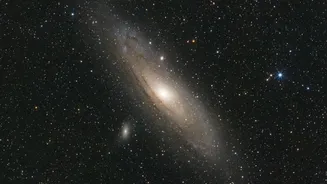
So why is Andromeda losing its creative spark? The primary cause appears to be a natural winding down after its previous, more active phase. Rather than running out of raw material, the galaxy is simply settling into a quieter period of evolution. However, there may be an external influence at play. Astronomers are looking closely at M32, a small satellite galaxy of Andromeda. Data shows that the area of Andromeda's disk near M32 has experienced an even greater decrease in star formation starting about 60 million years ago. While researchers can't definitively say M32 is the culprit, its proximity makes it the prime suspect for disrupting the gas clouds in that region and suppressing star birth.
A Glimpse of Our Cosmic Future
Studying Andromeda gives us a unique outside-in perspective on spiral galaxies like our own. While the Milky Way is currently more productive, it too will eventually exhaust its reserves of star-forming gas and begin a similar, long decline. Andromeda is essentially a preview of our galaxy's very distant future. But before that happens, a far more dramatic event is scheduled. In about 4.5 billion years, the Milky Way and Andromeda are set to collide and merge. This cataclysmic encounter will not involve stars crashing into each other—the space between them is too vast—but the gravitational chaos will compress huge clouds of interstellar gas. The result will be a final, brilliant burst of star formation across both galaxies, before they settle into a new, larger, and more placid elliptical galaxy, nicknamed 'Milkomeda'.