




The allure of prophecy is timeless, and none have captivated the public imagination quite like Nostradamus. But how do 16th-century poetic verses become modern-day warnings? Enter John Hogue, a leading, if controversial, interpreter.
The Modern 'Rogue Scholar'
John Hogue has built
a significant media presence as one of the world's foremost authorities on Nostradamus. Calling himself a 'rogue scholar', he has authored numerous books and appeared in countless documentaries and radio shows, offering his analysis of world events through the lens of ancient prophecies. Hogue positions himself as a futurist and an expert capable of decoding the complex and symbolic writings of not only Nostradamus but other seers as well. He has gained a reputation for making bold, often dire, predictions about politics, war, and economic shifts, which he ties back to his interpretations of these centuries-old texts. His work taps into a deep-seated public curiosity about the future, making him a go-to figure whenever current events feel chaotic and uncertain.
The Prophetic Clay
To understand Hogue's work, one must first understand his source material: the 'Prophecies' of Michel de Nostradamus. Published in 1555, the work consists of 942 four-line verses, or 'quatrains'. These were not written in plain language. Nostradamus used a cryptic mix of 16th-century French, Latin, Greek, and even made-up words. The quatrains are filled with anagrams, allegories, and symbolic imagery, and they are not presented in any chronological order. This deliberate obscurity makes the verses incredibly malleable. A single quatrain about a 'great fire' or a 'battle near a river' can be applied to dozens of historical or future events, depending on the interpreter's bias and focus. The text is less a clear roadmap of the future and more a collection of prophetic raw material waiting to be shaped.
From Quatrain to Headline
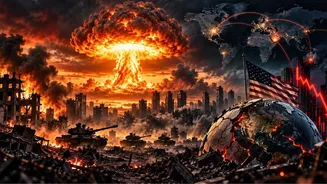
The core of Hogue's method lies in connecting Nostradamus's symbolic language to contemporary figures and events. This process is inherently subjective. For example, Hogue has focused on a figure named 'Mabus' in the quatrains, whom he identifies as the 'Third Antichrist'. Through anagrammatic reasoning, he has linked 'Mabus' to various public figures over the years, most recently suggesting it could refer to the Saudi Crown Prince, Mohammed bin Salman (MBS). Based on this link, he interprets quatrains about the death of 'Mabus' as a trigger for a 27-year-long global war. This is the essential role of interpretation: Hogue acts as a bridge, taking a vague name from a 500-year-old poem and assigning it a modern identity, thereby creating a specific, headline-grabbing prediction.
A Record of Ambiguity
The label 'unverified' attached to Hogue's predictions stems from several key criticisms. Skeptics point out that the prophecies are a classic case of 'retroactive clairvoyance'—they only seem to fit an event after it has already occurred. Many of Hogue's forwardward looking predictions have been incorrect or too vague to be proven either way. For instance, analyses of his past predictions show numerous misses, such as Al Gore winning the presidency and having a female vice president. Furthermore, critics note that the interpretive method allows for endless escape hatches; if a prediction doesn't come true, it can be argued that humanity 'changed its course' or that the interpretation was slightly off. Hogue himself has stated his warnings are meant to encourage people to choose peace, framing the prophecies not as fixed fate but as potential timelines that can be altered.